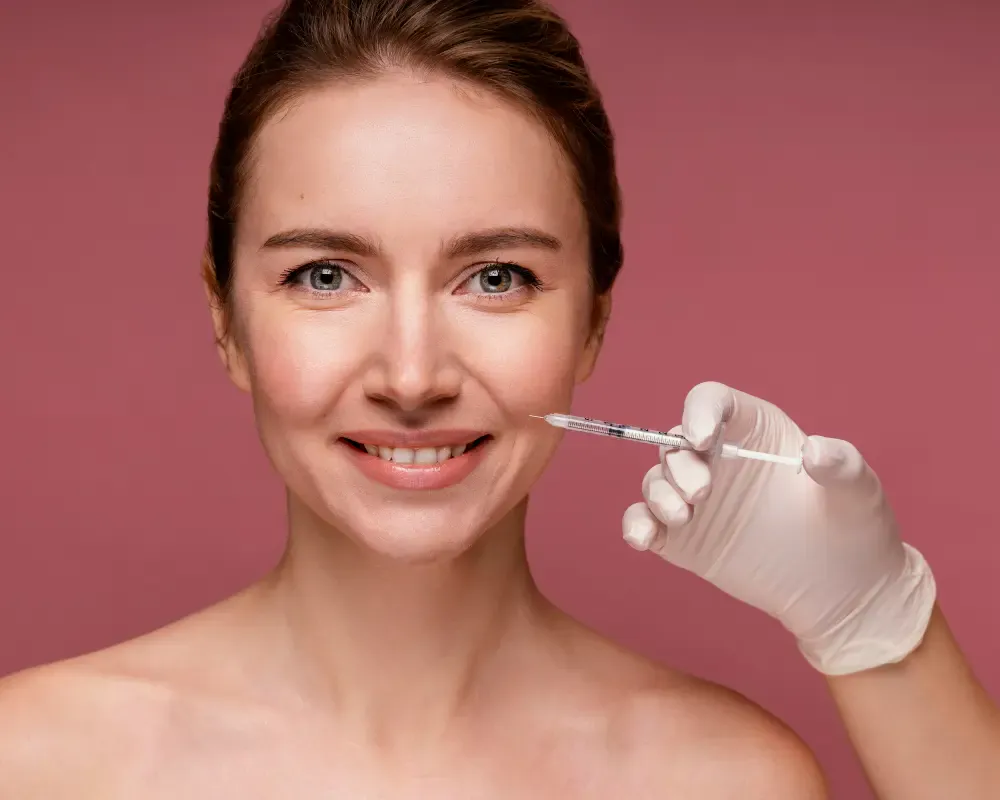
Anti-Wrinkle Treatment in London
GMC-registered doctors | Prescription-grade protocols | Tailored treatment plans for facial lines and wrinkles at 33 Cavendish Square
Duration
30-45 mins | Treatment 15-30mConsultation 30–45 mins | Treatment 15–30 mins
Sessions
1 (review at 2 weeks)1 (review at 2 weeks)
Price From
£200£200
Downtime
Minimal — most patients resume normal activities immediatelyMinimal — most patients resume normal activities immediately
Key Benefits
- Consultation-led approach with GMC-registered doctors only
- Personalised treatment plans tailored to your facial anatomy
- Specialist coverage of all facial zones, jawline, neck, and hyperhidrosis
- Premium CE-marked products from licensed UK suppliers
- Evidence-based protocols supported by peer-reviewed clinical research
- Mandatory two-week review to assess results and refine if needed
- Correction consultations available for unsatisfactory results from other providers
- Transparent pricing with no hidden fees
Common Target Areas
Anti-Wrinkle Treatment at PRP London Clinic
Anti-wrinkle treatment in London begins with a thorough medical consultation at PRP London Clinic, 33 Cavendish Square. Whether you are concerned about forehead lines, frown lines, or crow's feet, our GMC-registered doctors provide an evidence-based assessment of your facial lines and wrinkles to determine the most appropriate course of action for your individual anatomy and aesthetic goals.
As a dedicated anti-wrinkle clinic in London, we take a consultation-led approach. Certain treatments for dynamic facial lines involve prescription-only medicines that can only be administered following a face-to-face medical assessment. This page provides an overview of how we approach lines and wrinkles consultation, the science behind facial ageing, and the specialist treatment areas covered by our medical team — from the upper face and brow lift to jaw slimming, the Nefertiti neck lift, and medical management of hyperhidrosis.
This procedure is part of our comprehensive Guide to Signs of Ageing Skin.
Your Doctors for Anti-Wrinkle Treatment in London
Every anti-wrinkle treatment consultation and procedure at PRP London Clinic is carried out by a GMC-registered doctor — never a nurse or beautician. Our medical team includes Dr Bruno Amendola (GMC: 4346629), who holds an international postgraduate qualification in aesthetic medicine and Save Face accreditation with extensive experience across all facial zones; Dr Mohamed Nafei (GMC: 7520509), whose postgraduate training in aesthetic medicine and endocrinology informs a holistic approach to facial ageing; Dr Reem Nouri (GMC: 6149512), who combines general practice expertise with advanced aesthetic training for precise, natural-looking results; and Dr Mohammad Akbar (GMC: 5206673), our Founder and Medical Director, a Fellow of the Royal College of Surgeons of Edinburgh whose surgical background ensures the highest clinical standards across every anti-ageing treatment we provide at our London clinic.
Understanding Facial Lines and Wrinkles
Facial wrinkles develop through a combination of intrinsic and extrinsic ageing processes. Research demonstrates that intrinsic pathways — including genetics, reactive oxygen species generation, and hormonal changes — combine with extrinsic factors such as UV exposure and environmental damage to produce the lines, laxity, and skin thinning we associate with facial ageing. Understanding these mechanisms is essential to selecting the right treatment approach.
Dynamic Wrinkles
Dynamic wrinkles form from repeated muscle contractions during facial expressions. The most common areas include forehead lines (frontalis muscle), frown lines between the brows (glabellar complex), and crow's feet around the eyes (orbicularis oculi). These lines initially appear only during expression but can become permanently etched as collagen and elastin diminish over time.
Static Wrinkles
Static wrinkles are visible even when the face is at rest. They result from cumulative volume loss, collagen degradation, and gravitational changes. Static lines often require a combined approach that may include dermal fillers or skin-quality treatments alongside muscle-relaxing protocols.
Specialist Treatment Areas
Our anti-wrinkle treatment in London covers the following specialist areas, each with its own dedicated consultation page:
- Upper-face anti-wrinkle treatment — forehead lines, frown lines and crow's feet
- Brow lift and bunny lines — brow position enhancement and nasal scrunch lines
- Gummy smile treatment — excessive gum display correction
- Jaw slimming and bruxism treatment — masseter reduction and teeth-grinding relief
- Nefertiti neck lift — platysmal bands and jawline definition
- Hyperhidrosis treatment — medical management of excessive sweating
- Mesotox consultation — superficial micro-infusion for skin quality
What Happens During Your Anti-Wrinkle Consultation
Your lines and wrinkles consultation in London follows a structured medical protocol. The consulting doctor begins with a comprehensive medical history review, including any medications, allergies, or previous aesthetic treatments. A facial assessment examines muscle movement patterns, skin quality, volume distribution, and symmetry at rest and during expression.
Based on this assessment, your doctor discusses which treatment areas are appropriate and explains the clinical rationale for each recommendation. If treatment involves a prescription-only medicine, the doctor explains why it requires a prescription, how it works at a muscular level, expected onset and duration, and the specific risks relevant to your anatomy. A personalised treatment plan is mapped out, including dosing strategy and injection placement.
For patients proceeding on the same day, the treatment itself is typically completed within 15–30 minutes using ultra-fine needles. Topical anaesthetic is available for sensitive areas. The procedure is performed by the same doctor who conducted your consultation — ensuring continuity of care and precise execution of the agreed plan.
Your Anti-Wrinkle Treatment Journey
Book Your Consultation
Schedule an appointment online or by phone at PRP London Clinic, 33 Cavendish Square, London W1G 0PW. Allow 30–45 minutes for your initial visit.
Medical Assessment
Your GMC-registered doctor reviews your medical history, assesses your facial anatomy at rest and during expression, and identifies the specific muscles contributing to your lines and wrinkles.
Personalised Treatment Plan
Based on the assessment, your doctor recommends a tailored approach covering which areas to treat, expected outcomes, associated risks, and pricing. There is no obligation to proceed.
Treatment (If Proceeding)
If a prescription-only treatment is appropriate and prescribed, the administering doctor uses precise injection techniques refined through advanced aesthetic training. Treatment typically takes 15–30 minutes.
Aftercare Guidance
You receive specific aftercare instructions including activity restrictions for 24 hours. Results typically develop over 3–14 days depending on the treatment area and individual response.
Two-Week Review
A follow-up appointment assesses your response, checks for symmetry, and determines whether any refinement is needed to achieve the optimal outcome.
Ongoing Care Plan
Your doctor advises on maintenance intervals (typically 3–6 months) and any complementary treatments that may enhance or prolong your results.
Anti-Wrinkle Treatment Correction and Adjustment
If you have received treatment at another clinic and are unhappy with the outcome, PRP London Clinic offers a correction consultation to assess whether adjustment is possible. Common concerns include asymmetry, over-treatment resulting in a frozen appearance, under-treatment with inadequate effect, or complications such as brow ptosis or eyelid heaviness.
Correction depends entirely on the specific issue, the product used, how recently it was administered, and your individual anatomy. Our doctors assess each case individually — some issues can be addressed with targeted supplementary treatment, while others may require waiting for the existing treatment to wear off before retreatment with a revised approach. Not all outcomes can be corrected, and your doctor will provide an honest assessment of what is achievable. A consultation fee applies and is payable regardless of whether correction is possible.
Non-Surgical vs Surgical Approaches to Facial Ageing
| Factor | Non-Surgical Anti-Wrinkle Treatment | Surgical Facelift |
|---|---|---|
| Procedure time | 15–30 minutes | 3–6 hours under general anaesthetic |
| Downtime | Minimal — return to normal activities same day | 2–4 weeks recovery, bruising and swelling |
| Results onset | 3–14 days | Final results visible at 3–6 months |
| Longevity | 3–6 months (maintenance required) | 5–10 years |
| Best for | Dynamic wrinkles, expression lines, early signs of ageing, prevention | Significant skin laxity, deep folds, structural repositioning |
| Reversibility | Fully reversible — effects wear off naturally | Permanent structural changes |
| Anaesthesia | None or topical numbing cream | General anaesthetic required |
| Risk profile | Low — transient bruising, rare ptosis | Higher — nerve damage, scarring, infection, haematoma |
| Starting cost | From £200 | £8,000–£15,000+ |
Anti-Wrinkle Treatment Cost in London
Anti-wrinkle treatment cost at PRP London Clinic starts from £200 and varies depending on the number of areas treated and the complexity of your personalised plan. Below is an overview of our treatment areas and their starting prices:
- Upper face (forehead, frown lines, crow's feet) — from £300
- Gummy smile — from £250
- Brow lift and bunny lines — from £275
- Mesotox / skin refinement — from £450
- Nefertiti neck lift — from £320
- Jaw slimming / bruxism — from £450
- Hyperhidrosis (excessive sweating) — from £500
A detailed quote is provided during your consultation based on your treatment plan. All pricing is transparent with no hidden fees. Consultation fees are deducted from the treatment cost if you proceed on the same day.
Safety and Side Effects of Anti-Wrinkle Treatment
The safety profile of botulinum toxin for facial rejuvenation is well-established. A meta-analysis of 32 randomised controlled trials involving 9,669 patients confirmed an acceptable overall safety profile, with injection site reactions occurring at similar rates to placebo. The most commonly reported side effects include:
- Mild bruising or swelling at injection sites (resolves within days)
- Temporary headache — the most common adverse effect, typically resolving within 3–4 days
- Localised tenderness
- Temporary eyelid heaviness (rare, technique-dependent)
At PRP London Clinic, all anti-wrinkle treatments are administered by GMC-registered doctors with advanced aesthetic training, which significantly reduces technique-dependent risks. We use only premium, CE-marked products sourced directly from licensed UK suppliers. Every patient receives a thorough pre-treatment assessment to identify contraindications and a two-week follow-up review to ensure optimal outcomes and address any concerns.
Aftercare Following Anti-Wrinkle Treatment
First 24–48 Hours
- Remain upright for at least 4 hours after treatment
- Avoid touching, rubbing, or massaging the treated areas
- Do not apply makeup to injection sites for 12 hours
- Avoid strenuous exercise, saunas, steam rooms, and hot baths
- Limit alcohol consumption
- Sleep on your back if possible for the first night
First Two Weeks
- Results typically begin to develop within 3–5 days, with full effect at 10–14 days
- Avoid dental procedures for 2 weeks
- Do not have facials or facial massages for 2 weeks
- Attend your scheduled two-week review appointment
- Contact the clinic if you experience any unusual symptoms such as difficulty swallowing, breathing changes, or significant eyelid drooping
Your doctor will provide written aftercare instructions specific to your treatment areas at the time of your appointment.
Who Is Suitable for Anti-Wrinkle Treatment?
| Ideal Candidate | May Need an Alternative Approach |
|---|---|
| Adults with visible dynamic wrinkles (expression lines that deepen with movement) | Those with primarily static wrinkles and significant volume loss (may benefit more from dermal fillers or combination treatment) |
| Seeking subtle, natural-looking reduction in facial lines | Expecting complete elimination of all lines and wrinkles |
| In good general health with no neuromuscular conditions | Those with myasthenia gravis, Lambert-Eaton syndrome, or similar conditions |
| Not pregnant or breastfeeding | Currently pregnant, breastfeeding, or planning pregnancy in the near term |
| Committed to maintenance appointments every 3–6 months | Seeking a permanent one-time solution (surgical options may be more appropriate) |
| Realistic expectations following thorough consultation | Those who have not had a medical consultation or have unrealistic goals |
Contraindications for Anti-Wrinkle Treatment
Your suitability for anti-wrinkle treatment is determined during your medical consultation. The following conditions are contraindications:
- Neuromuscular disorders — myasthenia gravis, Lambert-Eaton syndrome, amyotrophic lateral sclerosis
- Pregnancy or breastfeeding — treatment is not administered during pregnancy or lactation
- Allergy or hypersensitivity — known allergy to botulinum toxin or any formulation excipients
- Active skin infection — any infection at the proposed injection site must be resolved first
- Bleeding disorders — including patients on anticoagulant therapy (discussed on a case-by-case basis)
- Certain medications — aminoglycoside antibiotics, muscle relaxants, or other medications that may interact
If you are unsure whether any of these apply to you, your consulting doctor will review your full medical history and advise accordingly. All decisions are made with patient safety as the primary consideration.
Medical Disclaimer
This page is intended for informational and educational purposes only. The content does not constitute medical advice, diagnosis, or a recommendation for any specific treatment. Certain treatments described involve prescription-only medicines that can only be prescribed by a qualified medical professional following a face-to-face assessment. Individual results vary, and outcomes cannot be guaranteed. All medical treatments carry risks, which will be discussed in full during your consultation. This content was last reviewed on 2 April 2026 by the medical team at PRP London Clinic.
Anti-Wrinkle Treatment Near You in Central London
PRP London Clinic is located at 33 Cavendish Square, London W1G 0PW, in the heart of Marylebone — one of London's most established medical districts. Our clinic is a short walk from Oxford Circus (Central, Victoria, and Bakerloo lines), Bond Street (Central and Jubilee lines), and Regent's Park (Bakerloo line). If you are searching for an anti-wrinkle clinic in London with GMC-registered doctors, convenient central access, and a consultation-led approach, PRP London Clinic provides specialist anti-ageing treatment in London across all facial zones, the jawline, neck, and medical hyperhidrosis management.
Book Your Anti-Wrinkle Consultation Today
Take the first step toward addressing your facial lines and wrinkles. Book a consultation with one of our GMC-registered doctors at PRP London Clinic to receive a personalised assessment and treatment plan tailored to your concerns. Whether you are considering anti-wrinkle treatment in London for the first time or seeking a second opinion on an existing concern, our medical team is here to help you make an informed decision.
Myths vs Facts
Anti-wrinkle treatment always results in a frozen, expressionless face.
When performed by experienced doctors using precise dosing, anti-wrinkle treatment softens lines while preserving natural facial movement and expression. The 'frozen' look results from over-treatment — our doctors tailor every plan to the individual's anatomy and preferences.
You need to wait until wrinkles are deep before seeking treatment.
Early consultation can be beneficial. Treating dynamic lines at an earlier stage may prevent them from becoming permanently etched static wrinkles. Research into the biological mechanisms of facial ageing supports addressing wrinkle formation before advanced skin structural damage occurs.
Anti-wrinkle injections are toxic and dangerous.
Botulinum toxin is one of the most extensively studied aesthetic treatments in medicine. A Cochrane review of 65 randomised controlled trials involving 14,919 participants confirmed its efficacy with a well-characterised safety profile. Like all medical treatments, it carries risks which are minimised by treatment from qualified, experienced doctors.
All clinics offering anti-wrinkle treatment in London are the same.
There are significant differences in practitioner qualifications, product quality, treatment protocols, and aftercare standards. At PRP London Clinic, treatments are only performed by GMC-registered doctors using premium CE-marked products, with a structured consultation-first approach and mandatory two-week review.
Once you start anti-wrinkle treatment, you can never stop.
Anti-wrinkle treatment is fully reversible. If you choose to stop, your muscles gradually return to their normal activity and your appearance returns to its pre-treatment state. There is no dependency and no worsening of wrinkles from discontinuing treatment.
Anti-wrinkle treatment is only for women.
An increasing number of men seek anti-wrinkle treatment for concerns including forehead lines, frown lines, and jaw slimming for bruxism. Treatment is tailored to male facial anatomy, which typically requires different dosing and injection patterns to achieve natural-looking results.
Frequently Asked Questions
Clinical Evidence & Scientific References
Gangigatti (2021): Efficacy and safety of Botulinum toxin A for improving esthetics in facial complex: A systematic review
Ritu Gangigatti, Vincent Bennani, John Aarts, Joanne Choi, Paul Brunton · Brazilian Dental Journal, 2021PMID: 34787249
Supports: Systematic review of 25 studies confirming botulinum toxin A is efficient and safe at all recommended dosages for facial aesthetics. Moderate-to-severe cases in glabellar, lateral canthal, and forehead regions showed higher improvement rates between 20U–50U with effect lasting up to 120 days. No correlation found between dosage and side effects.
Limitations: Quality appraised via GRADE but heterogeneity across included studies. Gender and age effects noted but not deeply stratified. Adverse effect data limited to short-term resolution (3–4 days). No long-term follow-up beyond the 120-day efficacy window.
View on PubMed →Camargo (2021): Botulinum toxin type A for facial wrinkles
Cristina Pires Camargo, Jun Xia, Caroline S Costa, Rolf Gemperli, Maria Dc Tatini, Max K Bulsara, Rachel Riera · Cochrane Database of Systematic Reviews, 2021PMID: 34224576
Supports: Cochrane review of 65 RCTs (14,919 participants) confirming botulinum toxin type A reduces wrinkles within four weeks of treatment with high-to-moderate certainty evidence. All commercially available formulations demonstrated significantly higher success rates versus placebo at week four, as assessed by both participants and physicians. Effect duration lasted approximately 20 weeks on average.
Limitations: Heterogeneous study designs (different BontA types, doses, cycles, facial regions) hindered meta-analysis. No studies were low risk of bias across all domains. Lack of evidence on multiple treatment cycles, long-term outcomes, and frequency of major adverse events. Most studies limited to glabellar region. Ptosis risk probably increased with treatment.
View on PubMed →Zargaran (2022): Facial skin ageing: Key concepts and overview of processes
David Zargaran, Florence Zoller, Alexander Zargaran, Tim Weyrich, Afshin Mosahebi · International Journal of Cosmetic Science, 2022PMID: 35426152
Supports: Comprehensive review of 65 papers mapping the biological mechanisms of facial ageing. Identifies intrinsic pathways (genetics, reactive oxygen species, hormonal changes) and extrinsic pathways (photoageing, skin layer damage) that combine to produce wrinkles, increased laxity, slackness, and skin thinning. Establishes the scientific foundation for understanding why dynamic lines and wrinkles form.
Limitations: Narrative review rather than meta-analysis — no pooled effect sizes. Literature search limited to studies up to 2020. Focused on mechanism description rather than treatment outcomes. Does not quantify the relative contribution of each ageing pathway.
View on PubMed →Gostimir (2022): Safety of Botulinum Toxin A Injections for Facial Rejuvenation: A Meta-Analysis of 9,669 Patients
Mišo Gostimir, Victor Liou, Michael K Yoon · Ophthalmic Plastic and Reconstructive Surgery, 2022PMID: 35353777
Supports: Meta-analysis of 32 RCTs involving 9,669 patients confirming the overall safety profile of botulinum toxin A is acceptable for cosmetic indications. BTX-A formulation type, treatment site, and total units were not significant covariates for adverse events. Injection site reactions and bruising occurred at similar rates to placebo.
Limitations: Pooled RR of any treatment-related adverse event was 1.53 vs placebo (statistically significant). Eyelid/eyebrow malposition risk was elevated (RR 3.55). Individual and total injection volume were significant covariates, suggesting technique-dependent safety. Literature search limited to January 2020.
View on PubMed →*PRP London Clinic provides these references for educational purposes. Our Clinical Board regularly reviews emerging peer-reviewed literature to ensure our protocols align with the latest advancements in regenerative medicine.
Quick Links
Our Medical Team
Your treatment will be performed by one of our qualified medical professionals

Dr Mohamed Nafei
GMC: 7520509GMC-registered doctor with 10+ years experience. Expert in PRP, exosomes, and ad...
Profile
Dr Reem Nouri
GMC: 6149512GMC-registered doctor with nearly 20 years of medical experience including 10+ y...
Profile
Dr Bruno Amendola
GMC: 4346629Highly sought-after aesthetic physician with decades of medical experience, inte...
Profile
Dr Mohammad Akbar
GMC: 5206673FRCS (Edinburgh) Fellow of the Royal College of Surgeons with extensive experien...
Scroll to see all
Ready to Get Started?
Book your consultation today and take the first step towards your transformation.
Book ConsultationVerified Clinical Reputation
Ruby K
19 Jan 2026
Norin Hanifi
19 Jan 2026
Dominique Heslop
13 Jan 2026
lloyda221
06 Jan 2026
Mane Authority
06 Jan 2026
Victor Contreras Guerra
4 months ago
A A
5 months ago
harris jan
3 months ago
Independent Patient Feedback
Read all verified stories →Medical Suitability Note
As a GMC-regulated practice, a mandatory consultation is required for all new patients to assess suitability and clinical need. This treatment may not be appropriate for everyone. All procedures are performed by GMC-registered doctors whose credentials can be verified on the official GMC register.