Facial Volume Loss & Ageing: The Complete Guide
Understanding Why Your Face Ages The 'Triangle of Youth': how facial volume shifts and descends with age Why does your face age? It's not just 'wrinkles'—in fact, wrinkles are often a symptom of deeper changes. The real drivers of facial ageing are structural: loss of volume, tissue descent, bone resorption, and skin quality deterioration.
Content Author & Reviewer
PRP London Clinic Medical Team
GMC-Registered Medical Professionals
Our team of GMC-registered medical professionals collaboratively review all medical content to ensure clinical accuracy and provide evidence-based information for patient education.




Last reviewed: August 27, 2026
Understanding Why Your Face Ages
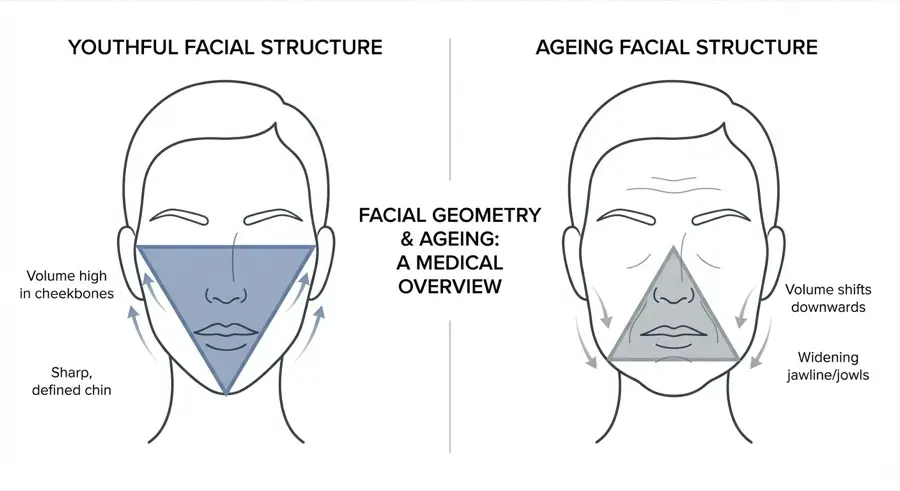

The Four Pillars of Facial Ageing
- 1. Fat Loss & Redistribution — Facial fat doesn't just disappear—it deflates in some areas and descends in others. The result is hollowing where you want fullness (cheeks, temples, under-eyes) and accumulation where you don't (jowls, nasolabial folds).
- 2. Bone Resorption — Your facial skeleton actually shrinks with age. The eye sockets enlarge, the jaw recedes, the cheekbones flatten. This removes the 'scaffolding' that soft tissue drapes over.
- 3. Muscle Changes — Some muscles become hyperactive (creating expression lines), others weaken (contributing to sagging). The balance that maintained youthful facial dynamics shifts.
- 4. Skin Quality Decline — Collagen, elastin, and hyaluronic acid all deplete. Skin becomes thinner, less elastic, and less able to 'bounce back.'
The 'Triangle of Youth' Inversion
Why Understanding This Matters
Who Experiences This Condition?
Common in
- •Everyone—facial volume loss is universal, though timing and pattern vary
- •Those with genetic predisposition to early volume loss (look at your parents)
- •People who have experienced significant weight fluctuations
- •Smokers—smoking dramatically accelerates all aspects of facial ageing
- •Those with high cumulative sun exposure
- •Individuals with naturally thin faces or less subcutaneous fat
- •People under chronic stress or with poor sleep patterns
Factors Affecting Severity
- •Genetics—the single biggest factor in ageing pattern and timing
- •Sun exposure history—UV is the most controllable ageing factor
- •Smoking history—accelerates ageing by 10+ years
- •Weight fluctuations—repeated gain/loss stretches skin
- •Sleep quality and chronic stress levels
- •Nutrition and overall health
- •Baseline facial structure and fat distribution
The Science of Facial Fat Loss
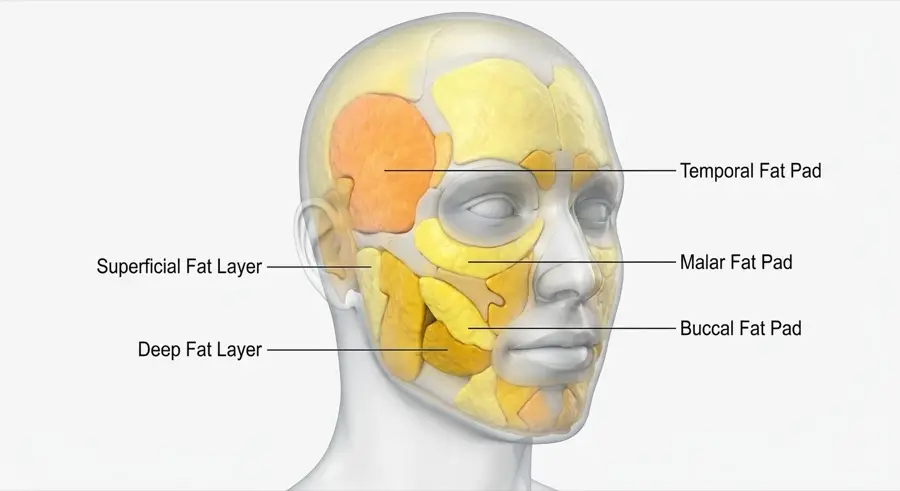
Contrary to popular belief, your face doesn't simply 'lose' fat with age—it's more complex than that. Fat deflates in some areas (creating hollowing) and descends in others (creating heaviness and folds).
Superficial vs Deep Fat
Your face has two fat layers: superficial (just under the skin) and deep (closer to bone and muscle). These age differently:
- Superficial fat: Tends to descend with gravity, sliding down the face over time
- Deep fat: Tends to shrink in place, creating hollowing without significant descent
Fat Compartments
Facial fat isn't a uniform layer—it's divided into distinct compartments (like segments of an orange) separated by ligaments. These compartments age at different rates, creating the characteristic patterns of facial ageing:
- Temples: Early deflation, often noticeable by 30s-40s
- Periorbital (around eyes): Both deflation and descent, causing hollowing and bags
- Cheeks: Mid-face volume loss and descent contributes to nasolabial folds
- Lower face: Fat accumulation along jawline (jowls) from descended tissue
Understanding which compartments are affected guides treatment—you don't treat jowls (descended fat) the same way you treat hollow temples (deflated fat).
Bone Resorption: The Hidden Driver of Ageing
This is the aspect of ageing that surprises most people: your facial bones actually shrink with age. This process, called bone resorption, removes the scaffolding that your soft tissue drapes over.
Key Areas of Bone Loss
- Eye sockets: Enlarge with age, contributing to under-eye hollowing and a 'sunken' appearance
- Cheekbones: Flatten and recede, reducing mid-face projection
- Jaw angle: Loses definition, contributing to jowl appearance
- Chin: Recedes backward, changing the profile and jaw-to-neck definition
Why This Matters for Treatment
If bone loss is a significant factor in your ageing, simply filling soft tissue may not produce natural results. Treatment needs to account for the changed underlying structure—sometimes by using firmer fillers that provide 'structural' support similar to what the bone once provided.
This is why facial rejuvenation is not just 'filling wrinkles'—it's architectural reconstruction based on understanding what's changed beneath the surface.
Area-by-Area: How Your Face Ages
Different areas of the face age in different ways—and require different approaches:
Under-Eye Area
One of the first areas to show age. Combines fat pad descent (bags), volume loss (hollowing), skin thinning (dark circles visible), and bone changes (enlarged eye socket). A complex area requiring careful assessment.
Learn more: Under-Eye Hollowing Guide →
Temples
Early fat deflation creates a hollowed, 'gaunt' appearance. Often overlooked but treating temples can significantly lift the eye area and soften overall appearance.
Mid-Face (Cheeks)
Volume loss and descent here has cascading effects: contributes to nasolabial folds, under-eye hollowing, and even jowling below. The cheeks are the 'keystone' of the face.
Explore: Cheek Fillers →
Nasolabial Region
The nose-to-mouth 'parentheses' lines form primarily from mid-face descent—tissue sliding downward creates a fold. Treating the cheeks above often helps more than filling the line directly.
Perioral (Around Mouth)
Vertical lip lines, thinning lips, elongation of the upper lip, and downturning of mouth corners. Combines muscle activity, volume loss, and skin changes.
Lower Face (Jawline)
Jowling results from tissue descent, SMAS weakening, and bone resorption. One of the most challenging areas to address non-surgically.
Learn more: Jowls & Sagging Guide →
Marionette Region
The lines from mouth to chin form from DAO muscle activity, volume loss, and descent from above. Often requires combination treatment.
Learn more: Marionette Lines Guide →
Facial Volume Loss in Your 20s and 30s
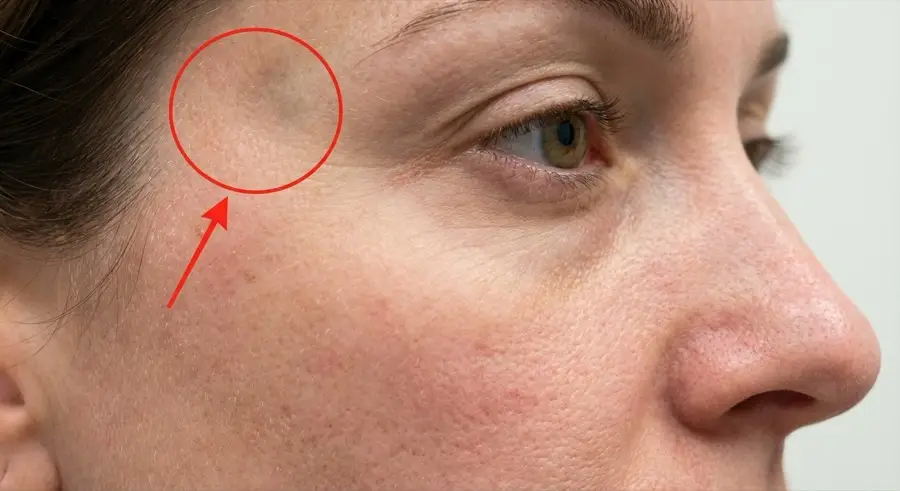
Searching 'facial volume loss 20s'? You're not imagining things—and you're not alone. While significant volume loss typically occurs later, subtle changes begin earlier than most people realise:
What's Normal in Your 20s
- Collagen production starts declining around age 25 (losing 1-2% per year)
- Early temple hollowing may begin
- Subtle changes in skin 'plumpness' and hydration
- First expression lines appearing (though these are different from volume loss)
What's Normal in Your 30s
- More noticeable temple hollowing
- Early softening of cheek definition
- Under-eye area beginning to show changes
- Skin elasticity starting to reduce
- Early nasolabial folds appearing
When Early Volume Loss Is More Pronounced
Some factors accelerate volume loss:
- Significant weight loss: Losing weight quickly can deflate the face
- Genetics: Some people are predisposed to earlier hollowing
- Naturally thin face: Less 'reserve' of facial fat
- High stress/poor sleep: Affects skin and overall ageing
- Sun damage history: Cumulative UV exposure accelerates all ageing
What You Can Do
In your 20s-30s, focus on prevention and prejuvenation:
- Rigorous sun protection (the single most important step)
- Retinoids to maintain collagen
- Good sleep and stress management
- Consider early interventions like Polynucleotides for skin quality or subtle filler to maintain rather than correct
Early intervention is about staying ahead of ageing rather than playing catch-up later.
Why Skincare Alone Won't Fix Volume Loss
Let's be direct: no serum, cream, or device you use at home can replace lost facial volume. Here's why:
What Skincare CAN Do
- Maintain skin health and hydration
- Support collagen production (retinoids)
- Protect against further UV damage (SPF)
- Improve surface texture and glow
- Marginally improve fine lines
What Skincare CANNOT Do
- Replace lost fat volume
- Lift descended tissue
- Reverse bone resorption
- Tighten significantly lax skin
- Fill deep folds or hollows
The Structural Reality
Facial volume loss is a structural problem—you've lost the underlying support that gave your face its youthful shape. No product applied to the surface can rebuild this infrastructure. It's like trying to fix a foundation problem by repainting the walls.
The Role of Professional Treatment
Meaningful improvement in facial volume loss requires treatments that address the structural cause:
- Dermal fillers: Physically replace lost volume and provide support
- Biostimulators: Trigger your body to produce new collagen
- RF treatments: Tighten skin and stimulate deep collagen remodelling
Skincare + Treatment Together
The best approach combines both: professional treatments address structural changes, while good skincare maintains skin quality and protects your investment. Neither alone is optimal.
Don't waste money on 'face-lifting' creams that promise the impossible. Invest in treatments that can actually make a difference, and use skincare for what it does well—maintaining skin health.
Understanding Your Treatment Options
| Ageing Factor | What's Happening | Treatment Approach |
|---|---|---|
| Volume Loss | Fat deflation creating hollowing | Dermal Fillers to replace volume |
| Tissue Descent | Fat and skin sliding downward | Structural filler for lift, RF for tightening, surgery for severe |
| Skin Laxity | Loss of collagen and elastin | Sylfirm X, Morpheus8 |
| Skin Quality | Thinner, drier, less resilient skin | Polynucleotides, Skin Boosters |
| Bone Loss | Facial skeleton shrinking | Structural fillers to provide 'scaffolding' |
The Combination Principle
The best facial rejuvenation results typically come from combining treatments that address multiple ageing factors. For example:
- Filler + RF: Replace volume AND tighten skin
- Filler + Polynucleotides: Restore structure AND improve skin quality
- Multipoint filler: Address temples, cheeks, chin for comprehensive lift
During consultation, we assess which factors are most significant in YOUR ageing pattern and design a protocol accordingly.
Why Choose PRP London Clinic
Facial rejuvenation requires understanding the complex interplay of factors that cause ageing. Here's why patients trust us:
Diagnostic-First Philosophy
We don't just see 'wrinkles' or 'hollowing'—we assess WHY these changes have occurred. Is it volume loss? Descent? Skin laxity? Bone change? The answer determines the treatment.
Educational Approach
We believe informed patients make better decisions. We explain what's happening in your face and why specific treatments are recommended—no pressure, no upselling.
Combination Expertise
The best results typically require multiple modalities. We design personalised protocols using the right combination of fillers, RF treatments, biostimulators, and skin boosters.
Natural Results Focus
Our goal is for you to look refreshed, not 'done.' We aim for results where people notice you look great—not that you've had work done.
GMC-Registered Medical Team
All treatments are performed by GMC-registered doctors with specialist training in facial anatomy and aesthetics.
Honest About Limitations
Some ageing changes respond better to surgery than non-surgical treatment. We'll always tell you honestly what's achievable and when a surgical referral might be more appropriate.
Treatment Process
Effective facial rejuvenation addresses the specific changes affecting YOUR face:
For Volume Loss Dermal fillers strategically placed to restore lost volume and structural support. Different areas require different approaches—cheek fillers for mid-face lift, temple fillers for upper face, and targeted filling for specific hollows.
For Skin Quality Polynucleotides to stimulate skin regeneration and improve thickness. Skin boosters (Profhilo, Seventy Hyal) for deep hydration and bioremodelling.
For Skin Tightening Sylfirm X or Morpheus8 RF treatments to stimulate collagen and tighten lax skin.
For Specific Concerns See our detailed guides for targeted treatment approaches:
Diagnosis & Assessment
Facial ageing is assessed through comprehensive facial analysis examining all four pillars: fat distribution and loss patterns, bone structure, muscle activity, and skin quality. We evaluate where volume has been lost vs redistributed, whether skin laxity is present, which muscles are contributing to lines, and overall skin health. This diagnostic approach ensures treatment addresses the actual causes of your specific ageing pattern rather than applying a one-size-fits-all approach.
Prevention & Management
Lifestyle Tips
- •Rigorous sun protection — UV damage is the biggest controllable factor; daily SPF is essential
- •Don't smoke — if you do one thing for your skin, stop smoking
- •Maintain stable weight — yo-yo dieting stretches skin and accelerates volume shifts
- •Prioritise sleep — poor sleep accelerates ageing
- •Manage stress — chronic stress affects skin quality and overall ageing
- •Use retinoids — the gold standard for maintaining skin thickness and quality
Home Care
- •Skincare can maintain skin quality but cannot replace lost volume or lift descended tissue
- •Different areas of the face require different treatment approaches
- •Early intervention ('prejuvenation') is more effective than treating advanced changes
- •Combination treatments addressing multiple ageing factors produce the best results
- •Not all ageing changes require or benefit from the same treatment
Symptoms & Causes
Common Symptoms
- Face appearing 'deflated' or less full than before
- Tired appearance despite adequate rest
- Shadowing and hollowing across the face
- Loss of 'youthful fullness' in the cheeks
- Skin appearing draped or loose
- Face looking longer or narrower than before
- Lines and folds becoming more prominent
- Looking older than your chronological age
Potential Causes
- Depletion and descent of superficial and deep facial fat pads with age
- Bone resorption causing shrinkage of the facial skeleton
- Progressive loss of collagen (1-2% per year after 20)
- Decline in elastin production causing skin laxity
- Reduction in hyaluronic acid leading to drier, thinner skin
- Weakening of the SMAS layer that supports facial structures
- Muscle changes affecting facial dynamics and expressions
- Cumulative sun damage (photoageing) breaking down dermal support
- Genetic programming determining individual ageing patterns
Treatment Options at PRP London
Dermal Fillers
The primary treatment for replacing lost facial volume, providing structural support and lift.
Learn moreCheek Fillers
Strategic mid-face volume restoration to lift the entire lower face and restore youthful contours.
Learn morePolynucleotides
Bio-regenerative treatment to improve skin quality, thickness, and elasticity across the face.
Learn moreSylfirm X
RF microneedling to tighten skin and stimulate collagen production for improved skin quality.
Learn moreSkin Boosters
Profhilo and other skin boosters to deeply hydrate and improve overall skin health.
Learn moreFrequently Asked Questions
Facial volume loss is caused by multiple factors: fat pad deflation and descent, bone resorption (your facial skeleton actually shrinks), collagen and elastin depletion in skin, and weakening of supportive tissue. Genetics determine your ageing pattern, while sun exposure, smoking, and weight fluctuations accelerate the process.
Collagen production starts declining around age 25, losing 1-2% per year. Most people notice visible volume loss in their late 30s to 40s, but this varies significantly based on genetics, lifestyle, and sun exposure. Some experience earlier changes due to weight loss, stress, or genetic predisposition.
Lost volume can be replaced with dermal fillers, but you can't reverse the underlying ageing process. Treatment focuses on restoring what's been lost and improving skin quality to slow further changes. Combination treatments addressing multiple ageing factors produce the most comprehensive results.
Accelerated facial ageing can result from: genetics (look at your parents), significant sun exposure history, smoking, significant weight fluctuations, chronic stress or poor sleep, and naturally thin facial structure with less fat 'reserve.' Addressing these factors where possible and considering treatment can help.
The 'best' treatment depends on what's causing your specific changes. Dermal fillers replace lost volume directly. Sylfirm X or Morpheus8 tighten skin. Polynucleotides improve skin quality. Most patients benefit from a combination approach.
No. Facial exercises cannot replace lost fat volume, reverse bone resorption, or lift descended tissue. Volume loss is a structural problem that requires structural solutions—fillers to replace volume, treatments to stimulate collagen, or surgery for significant laxity.
You can't stop ageing, but you can slow it: rigorous sun protection (the biggest controllable factor), don't smoke, maintain stable weight, use retinoids, get adequate sleep, and manage stress. Early 'prejuvenation' treatments can help maintain rather than correct.
Volume loss refers to fat deflation creating hollowing—tissue shrinking in place. Sagging (descent) is tissue sliding downward due to gravity and weakened support structures. They often occur together but require different treatment approaches.
The 'tired' appearance typically comes from: under-eye hollowing creating shadows, loss of cheek volume reducing light reflection, and downturned features from tissue descent. These are structural changes that happen regardless of how much sleep you get. Treatment addresses the anatomy, not the rest.
Not exactly. Facial volume loss from ageing involves fat pad changes, bone resorption, and structural decline independent of body weight. However, significant weight loss can accelerate facial hollowing as facial fat depletes along with body fat—often affecting the face more dramatically than desired.
Verified Clinical Reputation
Ruby K
19 Jan 2026
Norin Hanifi
19 Jan 2026
Dominique Heslop
13 Jan 2026
lloyda221
06 Jan 2026
Mane Authority
06 Jan 2026
Victor Contreras Guerra
4 months ago
A A
5 months ago
harris jan
3 months ago
Independent Patient Feedback
Verify on Google Reviews →Clinical Note: To protect patient confidentiality while maintaining educational clarity, some anatomical illustrations on this site utilise medically-verified, AI-generated models. Every anatomical demonstration is reviewed for clinical accuracy by our GMC-registered medical board.