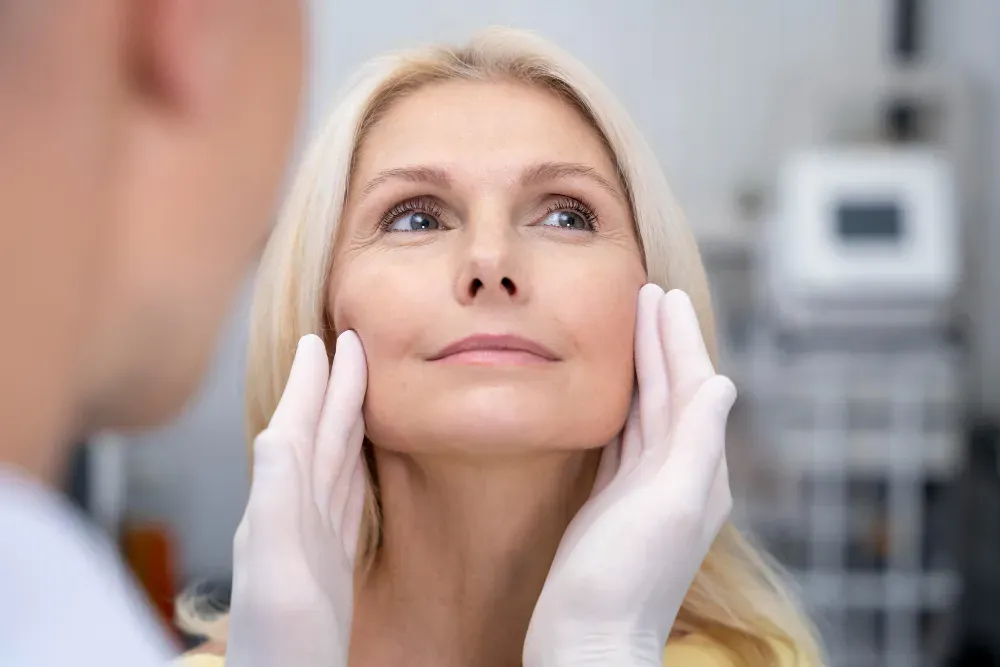
Upper Face Anti-Wrinkle Treatment in London
GMC-registered doctors | Forehead lines, frown lines & crow's feet treatment | Consultation-led at 33 Cavendish Square
Duration
15-20m15-20 mins
Sessions
1 (review at 2 weeks)1 (review at 2 weeks)
Price From
£300£300
Downtime
MinimalMinimal
Key Benefits
- Treats all three upper face zones — forehead, frown lines, and crow's feet — in one session
- Consultation-led approach with GMC-registered doctors only
- Personalised dosing calibrated to your individual anatomy and goals
- Subtle, natural-looking results preserving facial expression
- Quick procedure — typically 15–20 minutes for all areas
- Minimal downtime — return to normal activities the same day
- Fully reversible — effects wear off naturally if you choose not to maintain
- Mandatory two-week review to assess results and refine if needed
Common Target Areas
Forehead Lines, Frown Lines & Crow's Feet Treatment in London
Forehead botox London is one of the most frequently requested aesthetic treatments in the UK, and at PRP London Clinic we treat all three upper face zones — forehead lines, frown lines (the vertical '11s' between the brows), and crow's feet — under one consultation-led appointment at 33 Cavendish Square, London W1G. Every treatment is performed exclusively by a GMC-registered doctor, never a nurse or non-medical practitioner.
If you are researching forehead lines treatment London, frown lines treatment London, or crow's feet treatment London, this page explains the anatomy behind each concern, how prescription-only botulinum toxin works to relax the targeted muscles, what clinical evidence supports the treatment, and what you can realistically expect from a single session. Our approach is always consultation-first: your doctor assesses your facial anatomy, muscle activity, and goals before recommending whether treatment is appropriate and which areas to address.
This treatment sits within our comprehensive anti-wrinkle treatment programme. For brow lift and bunny lines, visit our brow lift & bunny lines page.
This procedure is part of our comprehensive Guide to Dynamic Wrinkles & Expression Lines.
Your Upper Face Treatment Doctors
Every upper face treatment London consultation and procedure at PRP London Clinic is performed by a GMC-registered doctor. Our medical team includes Dr Bruno Amendola (GMC: 4346629), who holds an international postgraduate qualification in aesthetic medicine and Save Face accreditation with particular expertise in forehead botox London and upper face rejuvenation; Dr Mohamed Nafei (GMC: 7520509), whose PgDip in Aesthetic Medicine and PgDip in Endocrinology inform a holistic, anatomy-led approach to frown lines treatment and crow's feet treatment protocols; Dr Reem Nouri (GMC: 6149512), whose MBBS, DRCOG, and advanced aesthetic medicine training enable precise forehead lines treatment London delivery with natural-looking results; and Dr Mohammad Akbar (GMC: 5206673), our Founder and Medical Director, a Fellow of the Royal College of Surgeons of Edinburgh whose surgical background ensures the highest clinical standards across every upper face procedure we perform.
Understanding Upper Face Lines and Wrinkles
Forehead Lines — The Frontalis Muscle
Forehead lines treatment London targets the frontalis muscle, the broad sheet of muscle spanning the forehead that is responsible for raising the eyebrows. Each time you express surprise, emphasis, or lift your brows, the frontalis contracts and creates horizontal creases across the forehead. Over years of repetitive movement — combined with age-related collagen and elastin loss — these dynamic lines become etched into the skin at rest. Targeted injection of small doses of botulinum toxin into the frontalis reduces the intensity of contraction, softening existing lines and slowing the formation of deeper static creases. Your doctor carefully calibrates the dosage to maintain natural brow movement and avoid a 'frozen' appearance.
Frown Lines (Glabellar Lines / '11s') — The Corrugator Supercilii and Procerus
Frown lines treatment London addresses the vertical creases between the eyebrows, commonly called '11 lines' or glabellar lines. Two muscle groups are responsible: the corrugator supercilii (paired muscles that draw the brows together and downward, creating the vertical furrows) and the procerus (a central muscle that pulls the skin between the brows downward, contributing to horizontal lines at the top of the nose). The Cochrane review by Camargo et al. (2021), which analysed 65 randomised controlled trials involving 14,919 participants, found that most studies focused on the glabellar region — confirming that this is the most extensively researched application of cosmetic botulinum toxin, with efficacy demonstrated within four weeks of treatment.
Crow's Feet — The Orbicularis Oculi
Crow's feet treatment London targets the lateral portions of the orbicularis oculi, the circular muscle that surrounds the eye. When you smile, squint, or laugh, the outer fibres of this muscle create the radiating lines at the outer corner of each eye known as crow's feet (periorbital lines). These lines are among the earliest signs of facial ageing because the periorbital skin is the thinnest on the face, with minimal subcutaneous fat for cushioning. Precise injection into three to five points along the lateral orbicularis oculi relaxes these fibres, softening the fan of lines while preserving your natural smile.
Why All Three Areas Are Often Treated Together
The forehead, glabellar complex, and periorbital muscles work as an interconnected system. Treating one area in isolation can sometimes create an imbalance — for example, treating forehead lines alone without addressing the frown line muscles can lead to brow heaviness, as the depressor muscles pull the brow downward unopposed. A comprehensive upper face treatment assessment considers the interplay between all three zones to deliver a balanced, natural result.
How Upper Face Anti-Wrinkle Treatment Is Performed
Forehead Lines — Injection Technique and Units
For forehead botox, your doctor identifies the optimal injection points across the frontalis muscle, typically 4–8 points arranged in a horizontal pattern above the brow line. Dosing generally ranges from 10–20 units depending on muscle mass, forehead size, and gender (male patients often require higher doses due to greater muscle bulk). The injections are placed at a sufficient height above the brow to avoid excessive brow ptosis, and the dose is distributed evenly to maintain symmetrical movement.
Frown Lines — Injection Technique and Units
For frown lines treatment, the corrugator supercilii and procerus are targeted using 5–7 injection points in the glabellar region. Typical dosing ranges from 15–25 units for the combined area. Your doctor assesses the depth and pattern of your frown lines during active expression to determine the precise placement and dose that will smooth the '11 lines' while preserving some natural movement in the brow area.
Crow's Feet — Injection Technique and Units
For crow's feet treatment, 3–5 injection points are placed laterally around each eye, targeting the outer fibres of the orbicularis oculi. Typical dosing ranges from 8–16 units per side. The injections are superficial and placed at least 1 cm from the orbital rim to avoid affecting the deeper muscles responsible for eye closure. Your doctor assesses your smile pattern to ensure the treatment softens the lines without flattening the natural crinkle that gives a genuine smile its warmth.
Combined Upper Face Treatment
When all three areas are treated in a single session — which is common — the total procedure takes approximately 15–20 minutes. Your doctor plans the combined dosing strategy to ensure balance across the entire upper face. Ultra-fine needles are used throughout, and most patients describe only a brief, mild pinch at each injection point. No anaesthesia is required, though topical numbing cream is available.
Your Upper Face Treatment Journey
Book Your Consultation
Schedule an appointment online or by phone at PRP London Clinic, 33 Cavendish Square, London W1G 0PW. Allow 30 minutes for your initial visit.
Face-to-Face Assessment
Your GMC-registered doctor reviews your medical history, examines the forehead, glabellar, and periorbital areas at rest and during expression, photographs your baseline, and assesses muscle activity and skin quality across the upper face.
Personalised Treatment Plan
Based on the assessment, your doctor recommends which of the three upper face zones to treat, the dosing strategy for each area, expected outcomes, associated risks, and pricing. There is no obligation to proceed.
Consent and Preparation
If proceeding, your doctor explains the treatment in full, answers any remaining questions, and obtains written informed consent. The treatment area is cleansed and marked.
Treatment
Using ultra-fine needles, your doctor administers precisely placed injections across the agreed upper face zones. The combined procedure typically takes 15–20 minutes.
Aftercare Guidance
You receive specific aftercare instructions including remaining upright for 4 hours, avoiding rubbing the treated areas, and activity restrictions for 24 hours. Results develop over 3–14 days.
Two-Week Review
A follow-up appointment assesses your results across all treated areas, checks symmetry, and identifies whether any refinement is needed. Top-up doses are administered at this stage if required.
Upper Face Correction and Second-Opinion Consultations
If you have received forehead botox, frown line, or crow's feet treatment at another clinic and are unhappy with the outcome, PRP London Clinic offers a correction consultation. Common concerns we assess include an overly frozen or expressionless forehead, brow heaviness or ptosis from incorrect frontalis dosing, asymmetry between left and right sides, under-treatment with insufficient wrinkle reduction, 'Spock brow' (peaked lateral brow from uneven dosing), or compensatory lines appearing in untreated adjacent areas.
Our doctors assess each case individually to determine whether correction is achievable. In some instances, targeted supplementary treatment can address asymmetry or under-treatment. In cases of over-treatment or brow heaviness, the most appropriate course is usually to allow the existing treatment to wear off before retreating with a revised protocol. Your doctor will provide an honest assessment of what can realistically be achieved. A consultation fee applies regardless of whether correction is possible.
Non-Surgical Upper Face Treatment vs Surgical Options
| Factor | Non-Surgical Upper Face Treatment (Injection) | Surgical Brow Lift / Forehead Lift |
|---|---|---|
| Procedure time | 15–20 minutes | 1–2 hours under general anaesthetic |
| Anaesthesia | None or topical numbing cream | General anaesthetic or sedation |
| Downtime | Minimal — return to normal activities same day | 1–3 weeks recovery, significant bruising and swelling |
| Results onset | 3–14 days | Final results at 3–6 months post-surgery |
| Areas treated | Forehead lines, frown lines, crow's feet — individually or combined | Brow position and forehead skin primarily |
| Longevity | 3–4 months (maintenance required) | 5–10 years |
| Scarring | None | Small incisions behind the hairline |
| Reversibility | Fully reversible — effects wear off naturally | Permanent structural changes |
| Risk profile | Low — mostly transient bruising, headache; rare ptosis | Higher — nerve damage, scarring, infection, asymmetry |
| Best for | Dynamic lines, early-to-moderate static lines, crow's feet | Severe brow ptosis, deep structural laxity, excess skin |
| Starting cost | From £300 | £4,000–£8,000+ (surgical) |
Forehead Botox Cost London
Forehead botox cost London at PRP London Clinic starts from £300. The final price depends on which upper face areas you are treating (forehead lines, frown lines, crow's feet, or a combination), the number of units required for your individual anatomy, and whether you are combining with adjacent areas such as a brow lift. A detailed, transparent quote is provided during your consultation with no hidden fees.
Many patients choose to treat all three upper face zones in a single session for a comprehensive, balanced result. Your doctor will discuss all options and associated costs during your assessment. Consultation fees are deducted from the treatment cost if you proceed on the same day.
Safety of Upper Face Anti-Wrinkle Treatment
The safety of botulinum toxin for upper face treatment is comprehensively documented in the clinical literature. A systematic review and meta-analysis published in the Aesthetic Surgery Journal (Zargaran et al., 2022), which analysed 24 studies covering 4,268 injection sessions specifically in the glabellar and forehead region, found an overall complication rate of 16% — with the vast majority of complications mild and transient. Headache was the most commonly reported adverse effect at 6.3%, followed by local skin reactions at 3.8%. Most side effects resolved without intervention within days.
A separate meta-analysis of 32 randomised controlled trials involving 9,669 patients (Gostimir et al., 2022) confirmed the overall acceptable safety profile of cosmetic botulinum toxin when administered by qualified practitioners, with injection site reactions occurring at similar rates to placebo.
The most significant technique-dependent risk for forehead botox is brow ptosis (heaviness) from over-treatment of the frontalis muscle, and for crow's feet treatment, temporary cheek puffiness if product affects the zygomaticus. These risks are minimised by precise injection placement, conservative dosing, and the expertise of a GMC-registered doctor. At PRP London Clinic, all upper face treatments are administered by qualified medical doctors with advanced aesthetic training.
Aftercare Following Upper Face Treatment
First 24–48 Hours
- Remain upright for at least 4 hours after treatment
- Avoid touching, rubbing, or massaging the forehead, brow, and periorbital areas
- Do not apply makeup to injection sites for 12 hours
- Avoid strenuous exercise, saunas, steam rooms, and hot baths
- Do not wear tight headbands, hats, or heavy-framed eyeglasses that press on the forehead
- Limit alcohol consumption
- Sleep on your back if possible for the first night
First Two Weeks
- Results typically begin to appear within 3–5 days, with the full effect visible at 10–14 days
- Avoid dental procedures for 2 weeks
- Do not have facials or facial massages for 2 weeks
- Avoid prolonged bending or lying face-down
- Attend your scheduled two-week review appointment
- Contact the clinic immediately if you experience significant eyelid drooping, difficulty closing the eye, or any unusual symptoms
Your doctor will provide written aftercare instructions specific to the areas treated at the time of your appointment.
Who Is Suitable for Upper Face Anti-Wrinkle Treatment?
| Ideal Candidate | May Need an Alternative Approach |
|---|---|
| Dynamic forehead lines that deepen with expression | Very deep static forehead creases present at rest (may benefit from combination with dermal fillers or skin resurfacing) |
| Visible frown lines or '11s' between the brows | Deep, etched glabellar folds unresponsive to muscle relaxation alone (may require combination treatment) |
| Crow's feet that appear during smiling or squinting | Significant periorbital skin laxity or volume loss (may benefit from dermal fillers or surgical blepharoplasty) |
| Seeking a subtle, natural reduction in upper face lines | Expecting complete eradication of all lines or a permanently frozen appearance |
| In good general health with no neuromuscular conditions | Those with myasthenia gravis, Lambert-Eaton syndrome, or similar conditions |
| Not pregnant or breastfeeding | Currently pregnant, breastfeeding, or planning pregnancy in the near term |
| Committed to maintenance every 3–4 months for sustained results | Seeking a permanent, one-time solution |
Contraindications for Upper Face Treatment
Your suitability for forehead botox, frown lines treatment, and crow's feet treatment is determined during your face-to-face medical consultation. The following conditions are contraindications:
- Neuromuscular disorders — myasthenia gravis, Lambert-Eaton syndrome, amyotrophic lateral sclerosis
- Pregnancy or breastfeeding — treatment is not administered during pregnancy or lactation
- Allergy or hypersensitivity — known allergy to botulinum toxin or any formulation excipients
- Active skin infection — any infection at the proposed injection site must be resolved first
- Bleeding disorders — including patients on anticoagulant therapy (discussed on a case-by-case basis)
- Certain medications — aminoglycoside antibiotics, muscle relaxants, or other medications that may interact with botulinum toxin
- Unrealistic expectations — patients expecting complete line eradication or permanent results may not be suitable candidates
If you are unsure whether any of these apply to you, your consulting doctor will review your full medical history and advise accordingly. All treatment decisions are made with patient safety as the primary consideration.
Medical Disclaimer
This page is intended for informational and educational purposes only. The content does not constitute medical advice, diagnosis, or a recommendation for any specific treatment. Certain treatments described involve prescription-only medicines that can only be prescribed by a qualified medical professional following a face-to-face assessment. Individual results vary, and outcomes cannot be guaranteed. All medical treatments carry risks, which will be discussed in full during your consultation. This content was last reviewed on 2 April 2026 by the medical team at PRP London Clinic.
Upper Face Treatment Near You in Central London
PRP London Clinic is located at 33 Cavendish Square, London W1G 0PW, in the heart of Marylebone — one of London's most established medical districts. Our clinic is a short walk from Oxford Circus (Central, Victoria, and Bakerloo lines), Bond Street (Central and Jubilee lines), and Regent's Park (Bakerloo line). If you are searching for forehead botox London with GMC-registered doctors, convenient central access, and a consultation-led approach, PRP London Clinic provides specialist upper face treatment for forehead lines, frown lines, and crow's feet tailored to your individual anatomy.
Book Your Upper Face Anti-Wrinkle Consultation Today
Take the first step toward smoother, refreshed upper face skin. Book a consultation with one of our GMC-registered doctors at PRP London Clinic to receive a personalised assessment for forehead lines treatment London, frown lines treatment London, and crow's feet treatment London. Whether you are considering forehead botox for the first time, looking to treat all three upper face zones, or seeking a second opinion on a previous treatment, our medical team is here to help you make an informed decision.
Myths vs Facts
Forehead botox will freeze your entire forehead and leave you expressionless.
The 'frozen' look results from over-treatment, not from the procedure itself. At PRP London Clinic, your GMC-registered doctor uses precise, conservative dosing calibrated to your individual muscle strength and anatomy. The goal is to soften lines while preserving natural movement — you should still be able to raise your eyebrows, express surprise, and look animated. A two-week review ensures the result is natural and balanced.
When botox wears off, your wrinkles will come back worse than before.
This is a persistent myth with no clinical basis. When botulinum toxin wears off, the treated muscles gradually return to their normal activity, and your wrinkles return to their pre-treatment state — not worse. In fact, regular treatment can slow the progression of dynamic lines into deeper static creases by reducing repetitive muscle contraction over time.
Botox is only worth having once your wrinkles are deep and established.
Treating dynamic lines early — while they are still visible only during expression — is often more effective than waiting until deep static creases have formed. Botulinum toxin works by relaxing muscle contraction, which is most effective on movement-based lines. Deep, etched lines at rest may require combination treatment with dermal fillers or skin resurfacing for optimal results.
Everyone will be able to tell I have had forehead botox.
When administered by an experienced doctor using appropriate dosing, the result of forehead botox is a subtly smoother, more refreshed appearance — not a dramatically altered face. Most people will notice you look well-rested rather than identifying a specific treatment. Obvious results are typically the consequence of over-treatment or poor technique, which is why choosing a qualified, GMC-registered practitioner is essential.
Forehead botox is a one-size-fits-all treatment — everyone gets the same amount.
Upper face treatment should always be personalised. The number of units, injection points, and areas treated vary significantly between patients based on muscle mass, forehead size, gender, skin thickness, and aesthetic goals. A consultation-led approach, like the one used at PRP London Clinic, ensures every treatment plan is tailored to the individual rather than following a generic protocol.
You cannot treat crow's feet and forehead lines at the same time.
Treating all three upper face zones — forehead lines, frown lines, and crow's feet — in a single session is not only safe but often recommended. The upper face muscles work as an interconnected system, and a combined approach allows your doctor to balance the treatment across all areas for a harmonious, natural result.
Frequently Asked Questions
Forehead botox cost London at PRP London Clinic starts from £300. The final cost depends on which upper face areas you wish to treat (forehead lines, frown lines, crow's feet, or a combination) and the number of units your individual anatomy requires. A detailed, transparent quote is provided during your consultation with no hidden fees.
Forehead botox typically lasts 3–4 months, though this varies according to your metabolism, muscle strength, and the dosage used. First-time patients may find results wear off slightly sooner. With regular maintenance treatments, some patients report results lasting progressively longer as the treated muscles adapt. Your doctor will recommend an appropriate maintenance schedule at your two-week review.
The number of units for forehead botox varies depending on your muscle mass, forehead size, gender, and the depth of your lines. Typical dosing ranges from 10–20 units for the forehead (frontalis) alone, 15–25 units for frown lines (glabellar complex), and 8–16 units per side for crow's feet. Your doctor determines the precise dose during your consultation based on a thorough assessment of your anatomy and goals.
Yes. Crow's feet treatment using botulinum toxin is one of the most well-established aesthetic procedures. Precise injection into the lateral fibres of the orbicularis oculi muscle softens the radiating lines at the outer corner of each eye. The Cochrane review by Camargo et al. (2021) confirmed the efficacy of botulinum toxin for facial wrinkles across 65 randomised controlled trials. Most patients see significant softening of crow's feet within 7–14 days of treatment.
Frown lines, also called glabellar lines or '11 lines', are the vertical creases that form between the eyebrows when you frown, concentrate, or squint. They are caused by repeated contraction of two muscle groups: the corrugator supercilii (which draws the brows together) and the procerus (which pulls the skin between the brows downward). Over time, these dynamic lines can become etched into the skin at rest. Frown lines treatment relaxes these muscles to smooth the area while preserving natural expression.
Yes. A systematic review published in the Aesthetic Surgery Journal (Zargaran et al., 2022) analysed 4,268 injection sessions specifically in the upper face and found an overall complication rate of 16%, with the vast majority being mild and transient — headache (6.3%) and local skin reactions (3.8%) were the most common. A separate meta-analysis of 9,669 patients confirmed the acceptable safety profile of cosmetic botulinum toxin. The key to safe outcomes is treatment by a qualified, experienced practitioner, which is why all procedures at PRP London Clinic are performed by GMC-registered doctors.
Not when performed correctly. The 'frozen' look results from over-treatment — either too many units or injection into the wrong muscle fibres. At PRP London Clinic, your doctor takes a conservative, tailored approach: dosing is calibrated to your individual muscle strength and anatomy, with the goal of softening lines while preserving natural forehead movement and expression. A two-week review appointment allows your doctor to assess the result and make any adjustments if needed.
After upper face treatment, initial results typically become visible within 3–5 days as the targeted muscles begin to relax. The full effect develops over 10–14 days. The Cochrane review by Camargo et al. (2021) confirmed efficacy within four weeks of treatment across 65 randomised controlled trials. Your two-week review appointment is timed to assess the complete result and determine whether any refinement is needed.
Most patients describe the sensation during forehead botox as a brief, mild pinch at each injection point. Ultra-fine needles are used, and the entire upper face procedure typically takes just 15–20 minutes. Topical numbing cream is available if preferred, though most patients find it unnecessary. There is no recovery period, and you can return to your normal activities immediately after treatment.
Yes. Treating forehead lines, frown lines, and crow's feet in a single session is common and often recommended. The three upper face zones work as an interconnected muscular system, and treating them together allows your doctor to create a balanced, natural result. Treating one area in isolation can sometimes create an imbalance — for example, treating forehead lines without addressing frown lines may cause brow heaviness. Your doctor will advise on the optimal combination during your consultation.
All upper face treatment London consultations and procedures at PRP London Clinic are performed exclusively by GMC-registered doctors. Our team includes Dr Bruno Amendola, Dr Mohamed Nafei, Dr Reem Nouri, and Dr Mohammad Akbar (Medical Director, FRCS Edinburgh). Every treatment is delivered by the same doctor who conducts your consultation, ensuring continuity of care.
Forehead botox maintenance is typically required every 3–4 months to sustain results. The exact interval depends on your individual metabolism, muscle activity, and the dosage used. Some patients find they can gradually extend the interval between sessions as the treated muscles adapt over time. Your doctor will recommend a personalised maintenance schedule based on your response to treatment.
Forehead lines are the horizontal creases that run across the forehead, caused by the frontalis muscle raising the eyebrows. Frown lines (also called '11 lines' or glabellar lines) are the vertical creases between the eyebrows, caused by the corrugator and procerus muscles drawing the brows together. They are distinct concerns involving different muscle groups and require different injection patterns. Many patients have both and benefit from treating all upper face areas together for a balanced result.
Yes. By reducing the frequency and intensity of muscle contraction, forehead botox slows the progression of dynamic lines into deeper static creases. Patients who begin treatment while lines are still primarily dynamic (visible only during expression) often find they can prevent the formation of deep, etched lines that would otherwise develop over time. This preventative approach is increasingly popular among patients in their late twenties and thirties.
Clinical Evidence & Scientific References
Camargo (2021): Botulinum toxin type A for facial wrinkles
Cristina Pires Camargo, Jun Xia, Caroline S Costa, Rolf Gemperli, Maria Dc Tatini, Max K Bulsara, Rachel Riera · Cochrane Database of Systematic Reviews, 2021PMID: 34224576
Supports: Cochrane review of 65 RCTs (14,919 participants). Most studies focused on glabellar region — directly relevant to upper face treatment. Confirms efficacy within four weeks.
Limitations: Heterogeneous study designs. Lack of evidence on multiple treatment cycles.
View on PubMed →Gostimir (2022): Safety of Botulinum Toxin A Injections for Facial Rejuvenation: A Meta-Analysis of 9,669 Patients
Mišo Gostimir, Victor Liou, Michael K Yoon · Ophthalmic Plastic and Reconstructive Surgery, 2022PMID: 35353777
Supports: Meta-analysis confirming acceptable safety profile. Injection site reactions at similar rates to placebo.
Limitations: Pooled RR 1.53 vs placebo. Eyelid malposition risk elevated.
View on PubMed →Zargaran (2022): Complications of Cosmetic Botulinum Toxin A Injections to the Upper Face: A Systematic Review and Meta-Analysis
David Zargaran, Florence Zoller, Alexander Zargaran, Eqram Rahman, Alexander Woollard, Tim Weyrich, Afshin Mosahebi · Aesthetic Surgery Journal, 2022PMID: 35178552
Supports: Systematic review of 24 studies (4,268 injection sessions) specific to upper face. Cosmetic botulinum toxin in glabellar and forehead regions is safe with most complications mild and transient. Overall complication rate 16%, headache most common (6.3%).
Limitations: Heterogeneous complication reporting. 70% of studies did not report practitioner training status. Lack of consistent complication definitions.
View on PubMed →*PRP London Clinic provides these references for educational purposes. Our Clinical Board regularly reviews emerging peer-reviewed literature to ensure our protocols align with the latest advancements in regenerative medicine.
Quick Links
Our Medical Team
Your treatment will be performed by one of our qualified medical professionals

Dr Mohamed Nafei
GMC: 7520509GMC-registered doctor with 10+ years experience. Expert in PRP, exosomes, and ad...
Profile
Dr Reem Nouri
GMC: 6149512GMC-registered doctor with nearly 20 years of medical experience including 10+ y...
Profile
Dr Bruno Amendola
GMC: 4346629Highly sought-after aesthetic physician with decades of medical experience, inte...
Profile
Dr Mohammad Akbar
GMC: 5206673FRCS (Edinburgh) Fellow of the Royal College of Surgeons with extensive experien...
Scroll to see all
Ready to Get Started?
Book your consultation today and take the first step towards your transformation.
Book ConsultationVerified Clinical Reputation
Ruby K
19 Jan 2026
Norin Hanifi
19 Jan 2026
Dominique Heslop
13 Jan 2026
lloyda221
06 Jan 2026
Mane Authority
06 Jan 2026
Victor Contreras Guerra
4 months ago
A A
5 months ago
harris jan
3 months ago
Independent Patient Feedback
Read all verified stories →Medical Suitability Note
As a GMC-regulated practice, a mandatory consultation is required for all new patients to assess suitability and clinical need. This treatment may not be appropriate for everyone. All procedures are performed by GMC-registered doctors whose credentials can be verified on the official GMC register.