Jowls & Lower Face Sagging
What Are Jowls? How jowls form: fat pad descent, skin laxity, and loss of jawline definition Jowls are the sagging skin and tissue that hang below the jawline, creating a droopy, aged appearance. They form when the structures that keep your lower face lifted—fat pads, muscle, and skin—begin to descend and lose their support.
Content Author & Reviewer
PRP London Clinic Medical Team
GMC-Registered Medical Professionals
Our team of GMC-registered medical professionals collaboratively review all medical content to ensure clinical accuracy and provide evidence-based information for patient education.




Last reviewed: August 27, 2026
What Are Jowls?
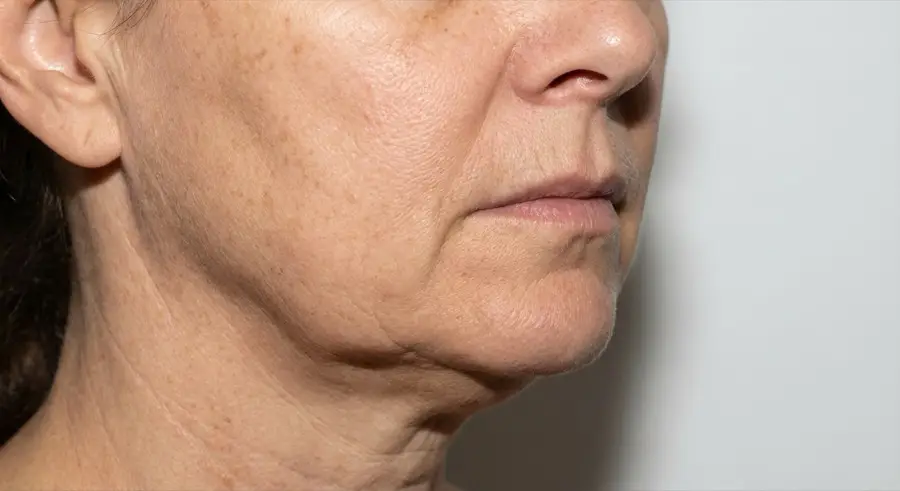
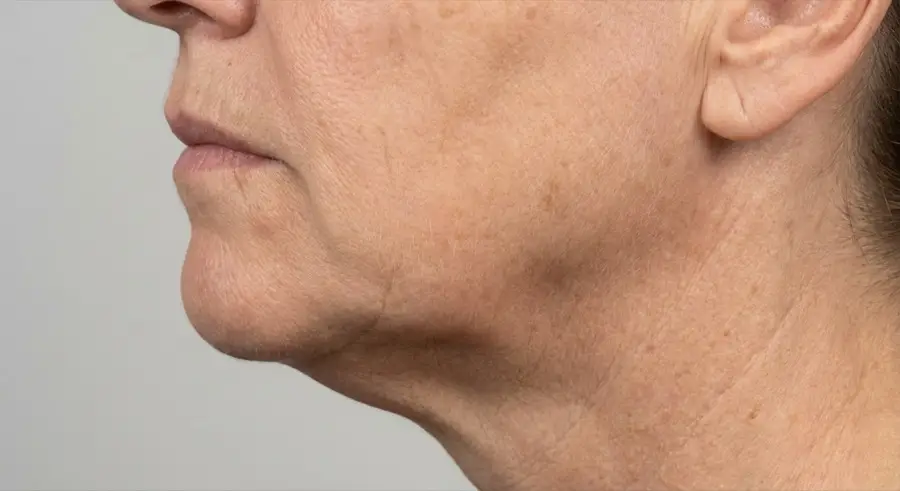
What Causes Jowls?
- Fat pad descent — The buccal fat pad and other deep facial fat compartments descend with gravity over time, pooling along the jawline
- Skin laxity — Loss of collagen and elastin means skin no longer snaps back; it sags
- SMAS weakening — The SMAS (superficial musculoaponeurotic system) is the fibrous layer that holds your face up. As it weakens, everything descends
- Bone resorption — The jawbone and chin actually shrink with age, reducing the 'scaffolding' that supports soft tissue
- Muscle laxity — The platysma muscle in the neck and lower face loses tone
Why Do Some People Get Jowls Earlier?
- Weight fluctuations — Repeated weight gain and loss stretches skin
- Sun damage — UV breaks down collagen and elastin
- Smoking — Dramatically accelerates skin ageing
- Thin skin — Less subcutaneous fat means less cushioning
- Weak jawline structure — Less bone support = earlier sagging
Can Jowls Be Fixed Without Surgery?
- Restore volume to lift and support (fillers)
- Tighten skin and stimulate collagen (RF treatments)
- Camouflage the jowl by enhancing surrounding areas (chin, jawline)
- Improve skin quality and elasticity (biostimulators)
Our Approach: Assessing Your Lower Face
- Degree of skin laxity — How much has skin lost its elasticity?
- Fat distribution — Is there descent, or is volume actually lost?
- Bone structure — Is the jawline naturally weak, or has it resorbed?
- Mid-face support — Are jowls partly caused by cheek descent above?
- Muscle tone — Is platysma banding contributing?
Who Experiences This Condition?
Common in
- •Individuals over 40 as skin laxity and fat descent accelerate with age
- •Those with genetic predisposition (look at your parents' lower face)
- •People who have experienced significant or repeated weight fluctuations
- •Smokers—smoking dramatically accelerates collagen breakdown
- •Those with naturally weak jawline bone structure
- •People with thin skin and less subcutaneous facial fat
- •Individuals with high sun exposure history
Factors Affecting Severity
- •Skin elasticity and collagen density
- •Degree of fat pad descent vs actual volume loss
- •Jawline and chin bone structure
- •Platysma muscle laxity and banding
- •History of weight fluctuations
- •Cumulative sun damage
- •Mid-face volume and support from above
Understanding Jowl Anatomy: Why Your Face Sags
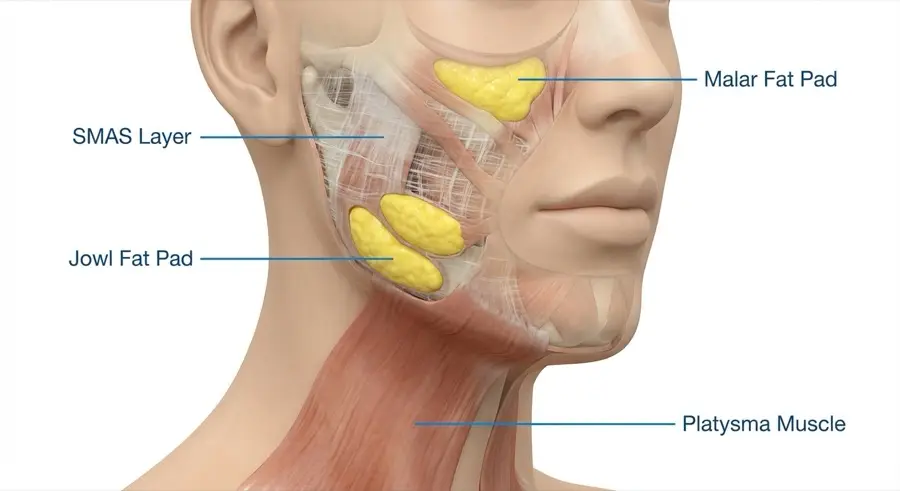
To understand jowls, you need to understand what holds your face up—and what happens when those structures fail:
The SMAS Layer
The superficial musculoaponeurotic system (SMAS) is a fibrous layer that connects your facial muscles to your skin. Think of it as a 'hammock' holding everything in place. As the SMAS weakens with age, it can no longer resist gravity—and tissue descends.
Fat Compartments
Your face has distinct fat compartments, not a uniform layer. The buccal fat pad and other deep compartments descend with age, pooling along the jawline. This is different from simply 'losing' facial fat—it's redistribution downward.
The Platysma Muscle
The platysma is a thin sheet of muscle running from your chest up to your lower face. As it loosens, it contributes to jowling and creates 'platysmal bands' in the neck.
Bone Resorption
Your jawbone and chin actually shrink with age—a process called resorption. This removes the 'scaffolding' that soft tissue drapes over, accelerating the appearance of jowls.
Understanding which of these factors is dominant in YOUR case determines the right treatment approach.
Grades of Jowling: Where Do You Fall?
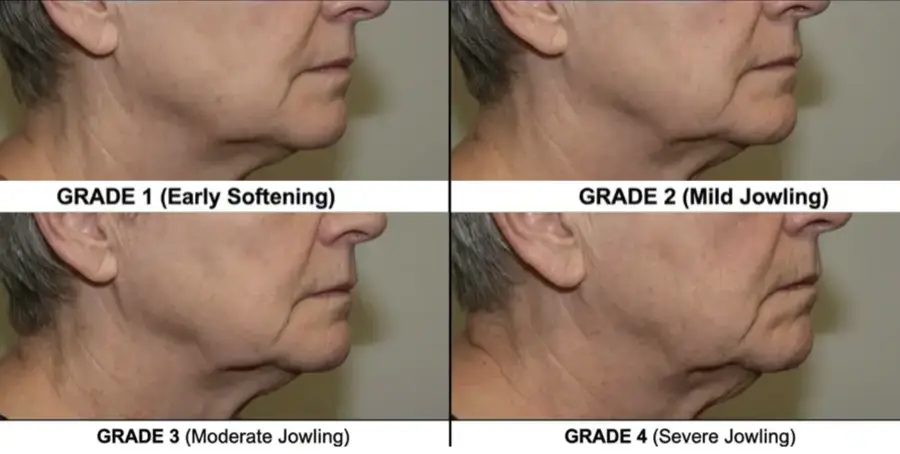
Grade 1 — Mild (Early Changes)
Early softening of the jawline. You might notice your jawline isn't as 'crisp' as it used to be, especially in photos or certain lighting. The tissue hasn't descended below the jawbone yet.
Treatment approach: Skin tightening (Sylfirm X), biostimulators (Polynucleotides), early filler for definition.
Grade 2 — Moderate
Visible jowling with tissue beginning to hang below the jawbone. The pre-jowl sulcus (the indent before the jowl) is noticeable. Jawline definition is clearly reduced.
Treatment approach: Strategic filler (chin, jawline, pre-jowl), RF treatments, combination protocols.
Grade 3 — Significant
Pronounced jowls with clear tissue descent. The jawline contour is significantly blurred. Often accompanied by marionette lines and neck laxity.
Treatment approach: Aggressive filler strategy, deep RF (Morpheus8), realistic expectations about non-surgical limits.
Grade 4 — Severe
Severe jowling with significant skin laxity and tissue descent. The jawline is largely obscured. Often combined with substantial neck sagging.
Treatment approach: Surgical consultation recommended. Non-surgical treatments may provide modest improvement but cannot replicate facelift results.
During consultation, we'll assess your grade and be honest about what non-surgical treatment can realistically achieve.
Ready to find your treatment path? Take our quick 3-question self-assessment.
Why Facial Exercises & Creams Won't Fix Jowls
If you've searched 'at home treatment for sagging jowls,' you've probably seen advice about facial exercises, jade rollers, and firming creams. Here's the truth:
Facial Exercises
Jowls are caused by tissue descent and skin laxity—not muscle weakness. Your facial muscles aren't 'weak'; the structures holding them up have failed. Exercising the muscles won't lift descended fat pads or tighten stretched skin. In fact, some argue that repeated muscle movement could accelerate wrinkling.
Firming Creams & Serums
No topical product can lift descended tissue. Creams can hydrate and marginally improve surface skin quality, but they cannot:
- Lift descended fat pads
- Tighten the SMAS layer
- Restore lost bone volume
- Reverse significant skin laxity
Jade Rollers & Gua Sha
These may feel pleasant and temporarily reduce puffiness through lymphatic drainage, but they have no effect on the structural causes of jowls.
What DOES Work
Meaningful jowl improvement requires treatments that address the structural causes:
- Fillers — Replace lost volume, provide structural support, camouflage descent
- RF treatments — Tighten skin, stimulate collagen remodelling
- Biostimulators — Improve skin quality and elasticity over time
- Surgery — The only option that can physically lift and remove excess tissue
Save your money on gadgets and miracle creams. Invest in treatments that can actually make a difference.
Jowls in Your 20s & 30s: Why It Happens Early
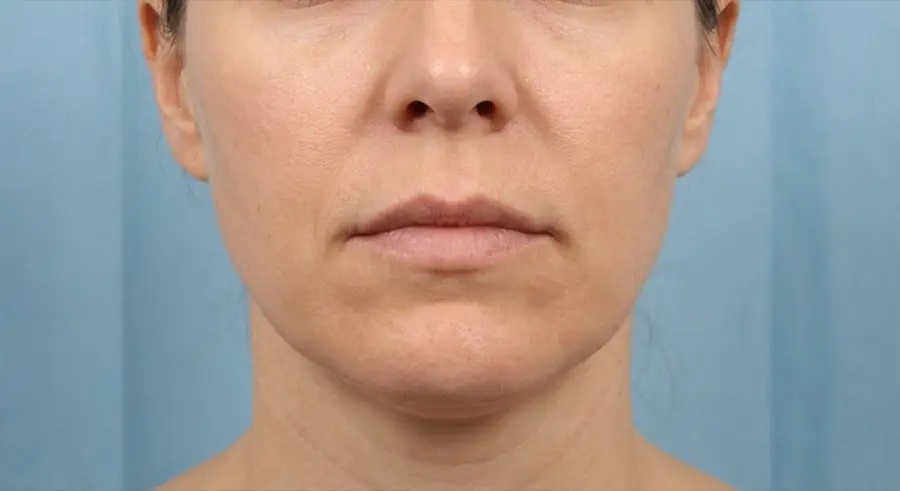
Searching 'jowls in 20s'? You're not alone—and you're not imagining it. While jowls typically appear in the 40s and beyond, some people notice early changes much sooner:
Why You Might Get Jowls Early
- Genetics: The biggest factor. If your parents had early jowling, you may too
- Weight loss: Significant weight loss in your 20s-30s can leave skin lax before it's had time to develop the resilience of mature skin
- Naturally weak chin/jawline: Less bone structure means less support for soft tissue
- Thin skin: Some people naturally have less subcutaneous fat, making descent more visible earlier
- Sun damage: Accumulated UV exposure from childhood onwards breaks down collagen
The Good News About Early Jowls
Treating jowls earlier is actually easier than treating them later:
- Skin still has reasonable elasticity
- Less tissue descent to address
- Treatments can slow progression, not just correct existing damage
- Collagen-stimulating treatments work better in younger skin
Early Intervention Options
For Grade 1-2 jowling in younger patients:
- Sylfirm X for skin tightening and collagen stimulation
- Polynucleotides for skin quality improvement
- Strategic chin or jawline filler for structural support
Early treatment is 'prejuvenation'—staying ahead of ageing rather than playing catch-up.
Does Masseter Botox Cause Jowls?
This is one of the most common questions we hear—and it's a valid concern. Let's address it directly:
The Theory
Masseter Botox (used for jaw slimming or teeth grinding) relaxes the masseter muscle, causing it to shrink. The concern is that this loss of muscle bulk removes support for the lower face, accelerating jowl formation.
The Evidence
There is some anecdotal and emerging evidence that aggressive, repeated masseter Botox over many years may contribute to lower face sagging in some patients—particularly those already prone to jowling. However:
- This typically requires high doses over extended periods
- Not everyone experiences this—genetics and baseline anatomy matter
- The jaw-slimming benefit may outweigh the risk for many patients
- Conservative dosing and treatment intervals can minimise risk
Our Approach
We take a considered approach to masseter Botox:
- Assess your baseline lower face laxity before treatment
- Use conservative doses rather than aggressive muscle reduction
- Monitor for any changes over time
- Discuss the trade-off honestly with patients concerned about jowling
- Consider alternatives for patients with existing lower face laxity
If you're concerned about this, discuss it at your consultation. We can assess your individual risk factors.
Treatment Options by Severity
| Grade | Recommended Treatments | How It Works | Expected Improvement |
|---|---|---|---|
| Grade 1 Early softening | Sylfirm X Polynucleotides | Skin tightening + collagen stimulation + skin quality | Excellent prevention, visible tightening |
| Grade 2 Moderate jowling | Chin Filler + Jawline Cheek Filler (lift from above) Sylfirm X | Structural support + camouflage + tightening | Good improvement, sharper jawline |
| Grade 3 Significant jowls | Strategic Filler Protocol Morpheus8 (deep RF) | Aggressive volume strategy + deep tissue remodelling | Moderate improvement, realistic expectations needed |
| Grade 4 Severe sagging | Surgical Consultation (Facelift/SMAS lift) | Physical lifting and removal of excess tissue | Best results for severe cases |
Important: This guide is for educational purposes. Treatment recommendations are made only after face-to-face assessment by a GMC-registered doctor, taking into account your anatomy, medical history, and goals.
When Surgery Is the Better Option
We believe in honesty. Non-surgical treatments are excellent for mild-moderate jowling, but they have limits. Here's when we recommend surgical consultation instead:
Signs You May Need Surgery
- Significant skin excess: If you can pinch a large amount of loose skin, it needs to be removed—not filled
- Grade 4 jowling: Severe descent that non-surgical treatments cannot adequately address
- Neck involvement: Significant neck banding and laxity usually requires surgical correction
- Previous non-surgical treatments haven't worked: If you've tried fillers and RF without satisfactory results
- Looking for dramatic change: Non-surgical provides improvement; surgery provides transformation
What a Facelift Can Do
A SMAS facelift physically lifts the descended tissue, tightens the underlying structures, and removes excess skin. It addresses the problem in a way that fillers and RF treatments cannot replicate for severe cases.
Our Approach
When we assess that surgery would serve you better than non-surgical treatment, we'll tell you honestly—and provide referrals to trusted facelift surgeons we've worked with. Some patients also benefit from non-surgical treatments:
- Before surgery: 'Prejuvenation' to optimise skin quality
- After surgery: Maintenance to preserve results over time
Our goal is the best outcome for you—even if that means referring you elsewhere.
Why Choose PRP London Clinic for Jowl Treatment
The lower face is one of the most challenging areas to treat non-surgically. Here's why patients trust us:
Diagnostic-First Approach
We don't just see 'jowls'—we assess WHY they've formed. Is it fat descent? Skin laxity? Bone loss? Poor mid-face support? The answer determines the treatment.
Combination Expertise
Effective jowl treatment usually requires multiple modalities—filler for structure, RF for tightening, biostimulators for skin quality. We design protocols that layer these treatments strategically.
Honest About Limitations
We won't promise non-surgical results that require surgery. If you're a Grade 4, we'll tell you—and provide a surgical referral if appropriate.
GMC-Registered Medical Team
The lower face is anatomically complex. All treatments are performed by GMC-registered doctors with specialist training in facial anatomy and aesthetics.
Natural Results Focus
Our goal is a refreshed, defined jawline—not an overfilled, unnatural look. We use filler strategically to support and define, not to mask with volume.
Premium Products Only
We use FDA-approved fillers (Juvederm, Restylane) and advanced devices (Sylfirm X, Morpheus8) for optimal safety and results.
Treatment Process
Our jowl treatment follows a diagnostic-first approach based on severity:
Mild Jowling (Early Intervention) For those noticing early loss of jawline definition:
- Skin tightening: Sylfirm X or Morpheus8 RF treatments to stimulate collagen and tighten skin
- Biostimulators: Polynucleotides to improve skin quality and elasticity
Moderate Jowling (Structural Approach) For visible jowls requiring camouflage and support:
- Strategic filler: Chin filler for projection, jawline filler for definition, pre-jowl sulcus filling
- Mid-face support: Cheek filler to lift from above
- Combination RF: Morpheus8 for deeper tightening
Severe Jowling (Surgical Consideration) For significant skin laxity and tissue descent:
- Non-surgical treatments have limitations—we'll be honest about expected improvement
- We provide referrals to trusted facelift surgeons when surgery is the better option
- Some patients benefit from non-surgical 'prejuvenation' before or maintenance after surgery
Diagnosis & Assessment
Jowls are assessed through clinical examination of the lower face and neck. We evaluate the degree of skin laxity using the 'pinch test,' assess fat distribution and descent, examine jawline bone structure, check for platysma banding, and consider mid-face support. Jowling is typically graded from mild (early loss of jawline definition) to severe (significant tissue hanging below the jawbone). Understanding your specific grade and the underlying causes—descent vs laxity vs volume loss—determines which treatments will be effective and whether surgical referral is more appropriate.
Prevention & Management
Lifestyle Tips
- •Maintain stable weight — yo-yo dieting stretches skin and accelerates sagging
- •Rigorous sun protection — UV damage is the biggest controllable factor in skin ageing
- •Don't smoke — smoking accelerates facial ageing by 10+ years
- •Consider early intervention — treating mild jowling is easier than severe
- •Maintain good posture — chronic 'tech neck' contributes to lower face sagging
Home Care
- •Makeup contouring can create the illusion of a more defined jawline
- •Hairstyles that frame the face can soften the appearance of jowls
- •Good skincare with retinoids helps maintain skin quality
- •Professional treatment is required for structural improvement—no cream will lift jowls
- •Facial exercises have no proven benefit for jowls (it's descent, not muscle weakness)
Symptoms & Causes
Common Symptoms
- Sagging skin along the jawline creating a droopy appearance
- Loss of definition between jaw and neck
- Skin hanging below the jawbone
- Blurring of the jawline contour
- Pre-jowl sulcus (indentation before the jowl)
- Marionette lines extending from mouth corners
- Aged or tired appearance despite feeling well
Potential Causes
- Descent of buccal fat pad and deep facial fat compartments with gravity
- Loss of collagen and elastin causing skin laxity
- Weakening of the SMAS (superficial musculoaponeurotic system)
- Resorption of jawbone and chin bone reducing structural support
- Platysma muscle laxity and loss of tone
- Cumulative sun damage breaking down dermal support
- Genetic predisposition to early or pronounced jowling
Treatment Options at PRP London
Dermal Fillers
Strategic filler placement in the jawline, chin, and pre-jowl sulcus to restore definition and camouflage sagging.
Learn moreNot sure which treatment is right for you?
Our quick assessment helps match your concerns to the best approach.
Chin Fillers
Chin projection and definition to create a stronger jawline and reduce the appearance of jowling.
Learn moreNot sure which treatment is right for you?
Our quick assessment helps match your concerns to the best approach.
Cheek Fillers
Mid-face volume restoration to lift and support the lower face, reducing the descent that causes jowls.
Learn moreNot sure which treatment is right for you?
Our quick assessment helps match your concerns to the best approach.
Sylfirm X
RF microneedling to tighten skin, stimulate collagen, and improve skin laxity along the jawline.
Learn moreMorpheus8
Deep RF treatment targeting fat and skin tightening in the lower face and jowl area.
Learn morePolynucleotides
Bio-regenerative treatment to improve skin quality, thickness, and elasticity in the lower face.
Learn moreFrequently Asked Questions
Jowls are caused by multiple age-related changes: descent of facial fat pads (particularly the buccal fat), weakening of the SMAS layer that holds the face up, loss of skin elasticity (collagen and elastin depletion), resorption of the jawbone and chin, and loosening of the platysma muscle. Genetics, weight fluctuations, sun damage, and smoking all accelerate jowl formation.
Yes, for mild to moderate jowling. Non-surgical options include dermal fillers (to restore structure and camouflage descent), RF treatments like Sylfirm X or Morpheus8 (for skin tightening), and biostimulators like Polynucleotides (for skin quality). However, severe jowling with significant skin excess typically requires surgical intervention for meaningful improvement.
The 'best' treatment depends on severity. For Grade 1-2: skin tightening (Sylfirm X) combined with strategic filler (chin, jawline, cheeks for lift). For Grade 3: more aggressive filler protocols with Morpheus8. For Grade 4: surgical facelift is typically the most effective option. We assess your specific anatomy before recommending any treatment.
Yes, when used strategically. Fillers don't directly 'fill' the jowl—they work by restoring structural support to surrounding areas. Chin filler creates projection, jawline filler restores definition, cheek filler provides lift from above, and pre-jowl sulcus filling smooths the transition. The result is a sharper jawline that camouflages the jowl.
Most people notice jowls beginning in their late 40s to 50s, but this varies significantly based on genetics, lifestyle, and anatomy. Some people with genetic predisposition, thin skin, or weak bone structure may notice changes in their 30s. Early intervention ('prejuvenation') can slow progression.
It's uncommon but possible, usually due to: significant weight loss (skin hasn't bounced back), genetic predisposition, naturally weak chin/jawline structure, or very thin facial skin. If you're noticing early jowling, it's worth consulting to understand the cause and consider early intervention.
There's emerging evidence that aggressive, repeated masseter Botox over many years may contribute to lower face sagging in some patients—the theory being that muscle shrinkage removes support. However, this isn't universal and typically requires high doses over extended periods. We use conservative dosing and assess individual risk factors.
Results vary by treatment: Dermal fillers last 12-18 months in the jawline/chin area. RF treatments (Sylfirm X, Morpheus8) stimulate collagen with results building over months and lasting 1-2 years with maintenance. Polynucleotides improve skin quality over a course of treatments with cumulative benefits. Surgical results last 7-10+ years.
A 'non-surgical jowl lift' typically combines multiple treatments: fillers for structural support and definition, RF treatments for skin tightening, and sometimes threads (PDO) for mechanical lifting. Results are more subtle than surgery but involve no incisions, minimal downtime, and can be maintained over time.
Consider surgical consultation if: you have significant skin excess that needs removal, you're Grade 4 with severe descent, you've tried non-surgical treatments without satisfactory results, you have significant neck involvement, or you want a dramatic rather than subtle change. We'll always be honest about when surgery is the better option.
Not Sure Which Jowl Treatment is Right for You?
Our 3-question self-assessment helps match your lower face concerns to the ideal treatment pathway. Results are educational only—your consultation will confirm the best approach.
Verified Clinical Reputation
Ruby K
19 Jan 2026
Norin Hanifi
19 Jan 2026
Dominique Heslop
13 Jan 2026
lloyda221
06 Jan 2026
Mane Authority
06 Jan 2026
Victor Contreras Guerra
4 months ago
A A
5 months ago
harris jan
3 months ago
Independent Patient Feedback
Verify on Google Reviews →Clinical Note: To protect patient confidentiality while maintaining educational clarity, some anatomical illustrations on this site utilise medically-verified, AI-generated models. Every anatomical demonstration is reviewed for clinical accuracy by our GMC-registered medical board.