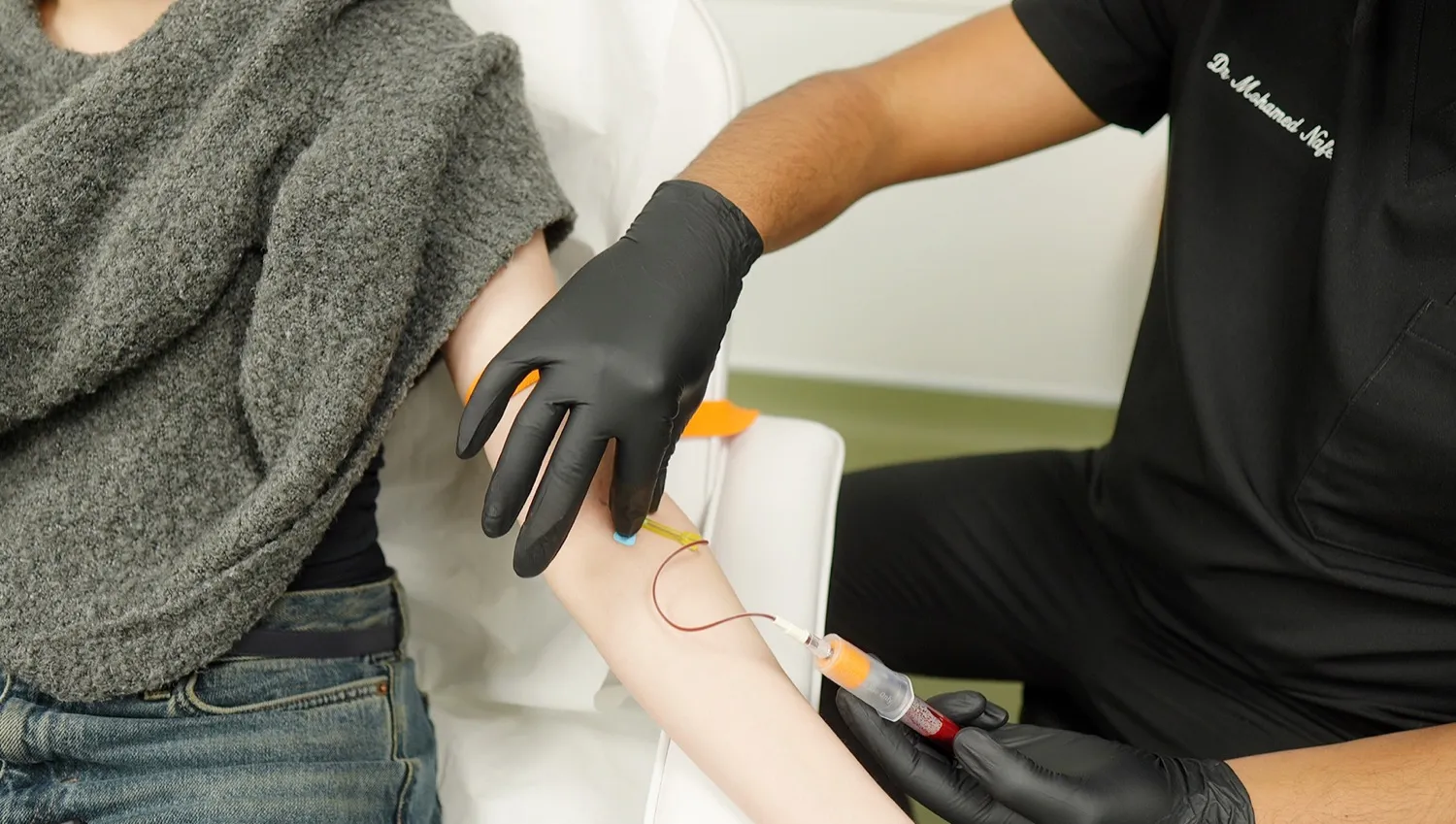




PRF hair loss treatment preparation using T-Lab PRF System at PRP London Clinic, London

PRF for Hair Loss London: Sustained Growth Factor Hair Restoration

Injectable platelet-rich fibrin delivers growth factors to scalp follicles over 10–14 days. GMC-registered doctors at 33 Cavendish Square, London W1G.

Duration

45-60m

Sessions

3-6

Price From

£295

Downtime

Minimal

Key Benefits

  • Sustained growth factor release over 10–14 days via fibrin matrix
  • 100% autologous and additive-free
  • 80% response rate demonstrated in 2025 clinical study
  • Anti-inflammatory leukocytes reduce scalp symptoms
  • Can be combined with PRP for a dual-protocol approach
  • Delivered by GMC-registered doctors using T-Lab PRF System

Common Target Areas

Crown (Vertex) Frontal Hairline Temporal Regions Diffuse Thinning Areas

PRF for Hair Loss: London's Specialist Clinic

PRF hair treatment london at PRP London Clinic uses injectable Platelet-Rich Fibrin (I-PRF) to deliver sustained growth factor stimulation directly to scalp follicles. Unlike standard PRP — which releases growth factors in a rapid burst — PRF for hair loss creates a fibrin matrix that maintains growth factor delivery over 10 to 14 days, providing a prolonged regenerative stimulus to dormant and miniaturising follicles.

At 33 Cavendish Square, London W1G, our team of GMC-registered doctors uses the T-Lab PRF System (CE Class IIB) to prepare injectable PRF for hair restoration. A 2025 prospective study found an 80% response rate in androgenetic alopecia patients receiving 6 monthly i-PRF injections, with significant improvements in hair density, scalp symptoms, and patient satisfaction.

For patients seeking the broadest regenerative approach, PRF can be combined with standard PRP for hair loss in a dual-protocol treatment plan.

Your PRF Hair Treatment Team

Every PRF hair treatment london session is performed by a GMC-registered doctor from our clinical team — Dr Bruno Amendola (GMC: 4346629), Dr Mohamed Nafei (GMC: 7520509), and Dr Reem Nouri (GMC: 6149512). Our doctors follow standardised PRF hair restoration treatment protocols developed through shared clinical workflows, ensuring consistent outcomes regardless of which physician performs your procedure. Never a nurse, technician, or non-medical practitioner.

How PRF Works for Hair Loss

The Fibrin Matrix and Hair Follicles

When injectable PRF is delivered into the scalp, the fibrin matrix provides a sustained-release scaffold for growth factors including PDGF, TGF-β, VEGF, and EGF. These growth factors signal dormant follicles into the anagen (active growth) phase, stimulate new blood vessel formation around follicles, and reduce the inflammation that contributes to follicular miniaturisation.

Androgenetic Alopecia (Male and Female Pattern Hair Loss)

PRF for hair loss is primarily indicated for androgenetic alopecia — the most common form of hair loss affecting both men and women. The sustained growth factor delivery may help counteract the effects of DHT-mediated follicular miniaturisation by stimulating cellular proliferation and angiogenesis at the follicular level.

Scalp Inflammation and Folliculitis

PRF retains a higher concentration of leukocytes compared to standard PRP. A 2025 clinical study demonstrated that i-PRF significantly reduced scalp inflammation scores — including folliculitis, greasiness, dandruff, and itching — alongside improvements in hair density.

PRF vs PRP for Hair: Which Is Better?

Patients often ask about prp vs prf for hair. Both are effective autologous treatments, but they work differently. PRP provides a higher volume of liquid platelet concentrate that can cover larger scalp areas, while PRF's fibrin matrix sustains growth factor delivery over a longer period. In some cases, your doctor may recommend combining both in a dual-protocol approach — using PRP for broad coverage and PRF for targeted, sustained stimulation at areas of greatest concern.

PRF Hair Treatment: Technique and Technology

T-Lab PRF System for Scalp Treatment

All PRF hair treatments are prepared using the T-Lab PRF System with the I-PRF protocol — 1500 RCF for 4 minutes. This produces a liquid fibrin concentrate optimised for scalp micro-injection, rich in platelets, leukocytes, and growth factors.

Injection Technique

Your doctor performs targeted micro-injections across the scalp using a fine-gauge needle, focusing on areas of greatest thinning or miniaturisation. The injection depth is calibrated to the dermal papilla level — where follicular stem cells reside and where growth factor stimulation is most effective.

Combination Protocols

PRF for hair can be combined with:

  • PRP for hair loss — dual-protocol for both immediate and sustained growth factor delivery
  • Mesotherapy — nutrient cocktail to complement the regenerative stimulus
  • Exosomes therapy — cellular signalling molecules for enhanced follicular activation

Your PRF Hair Treatment: Step by Step

Here is what to expect during your PRF hair treatment london appointment:

1

Consultation and Scalp Assessment

Your doctor reviews your medical history, examines your scalp and hair loss pattern, and confirms PRF suitability. Photographs may be taken for baseline comparison.

2

Blood Draw

A small sample (10–20ml) is drawn from your arm into additive-free T-Lab PRF tubes.

3

I-PRF Centrifugation

The sample is processed at 1500 RCF for 4 minutes. The natural clotting cascade forms a platelet-rich fibrin concentrate.

4

Scalp Numbing

Topical anaesthetic is applied to the treatment area for your comfort during the injection phase.

5

Targeted Micro-Injections

Your doctor delivers I-PRF via precise micro-injections across the scalp, focusing on areas of thinning, recession, or miniaturisation.

6

Review and Aftercare

Post-treatment instructions are provided. A follow-up is scheduled to assess your progress and plan subsequent sessions.

PRF vs PRP for Hair Loss

FactorPRF for HairPRP for Hair
PreparationNo anticoagulant — 100% additive-freeSodium citrate anticoagulant
Growth factor releaseSustained over 10–14 days (fibrin matrix)Immediate burst release
Leukocyte contentHigher — anti-inflammatory benefit for scalpLower in most preparations
Treatment volumeSmaller volume — targeted deliveryLarger volume — broader coverage
Sessions recommended3–6 monthly sessions3 sessions (4–6 weeks apart)
Evidence baseGrowing — 80% response rate in 2025 studyExtensive — multiple meta-analyses
Can combine?Yes — with PRP, mesotherapy, exosomesYes — with PRF, mesotherapy, exosomes

PRF Hair Treatment Pricing

PRF hair treatment london at PRP London Clinic starts from £295 per session. A course of 3–6 sessions is typically recommended for optimal results.

Your consultation includes a full scalp assessment, discussion of expected outcomes, and a clear treatment plan with itemised pricing. See the pricing table below for a full breakdown.

Is PRF for Hair Loss Safe?

PRF for hair loss has an excellent safety profile. As a 100% autologous, additive-free treatment, it virtually eliminates the risk of allergic reactions or rejection. A 2025 prospective study of 30 patients receiving monthly i-PRF for androgenetic alopecia reported minimal adverse reactions across all treatments.

Temporary side effects may include:

  • Mild redness or swelling at injection sites on the scalp (resolves within 24–48 hours)
  • Minor tenderness at injection points
  • Occasional pinpoint bleeding

All treatments are performed under sterile conditions by our GMC-registered doctors using single-use T-Lab PRF tubes.

PRF Hair Treatment Aftercare

First 24–48 Hours

  • Avoid washing your hair for 12–24 hours after treatment
  • Do not apply hair products (gel, wax, spray) for 24 hours
  • Skip strenuous exercise, saunas, and steam rooms
  • Avoid anti-inflammatory medications (ibuprofen, aspirin) — these can interfere with the fibrin-mediated healing response

First 2 Weeks

  • Use a gentle, sulphate-free shampoo
  • Protect the scalp from excessive sun exposure
  • Maintain good hydration

Follow-Up

Your doctor will schedule a follow-up to assess progress and discuss timing for subsequent sessions. Most PRF hair protocols recommend monthly sessions for 3–6 months, followed by maintenance every 3–6 months.

Is PRF for Hair Loss Right for You?

Ideal CandidateMay Need an Alternative Approach
Early-to-moderate androgenetic alopecia with existing folliclesComplete baldness with no remaining follicles (transplant may be needed)
Wants a 100% natural, additive-free hair treatmentPrefers standard PRP with established, extensive evidence base
Experiencing scalp inflammation alongside hair thinningHair loss caused by medication or systemic illness (requires medical management first)
Committed to a course of 3–6 monthly sessionsSeeking a single-session permanent solution
Healthy platelet count and no blood disordersPlatelet dysfunction, thrombocytopenia, or anticoagulant therapy

PRF Hair Treatment Contraindications

PRF for hair loss is not suitable for everyone. The following conditions are screened during your consultation:

  • Platelet dysfunction syndrome or critical thrombocytopenia
  • Active malignancy (cancer)
  • Sepsis or active systemic infection
  • Chronic liver disease
  • Blood-thinning medication — requires medical review
  • Pregnancy or breastfeeding
  • Active scalp infection at the proposed treatment site

Clinical Disclaimer

PRF for hair loss is a biological medical procedure. Individual results vary based on age, genetics, baseline hair density, stage of hair loss, and platelet function. While clinical evidence supports i-PRF's efficacy for androgenetic alopecia, PRF is a treatment to support natural hair regeneration — it is not a guaranteed cure for hair loss. A professional consultation is required to determine suitability.

Last medical review: March 2026.

PRF Hair Treatment at 33 Cavendish Square, London W1G

PRP London Clinic is located at 33 Cavendish Square, London W1G 0PW — in the heart of London's medical district. Our dedicated clinical premises provide a private, professional environment for all PRF hair treatment london sessions.

Book Your PRF Hair Loss Consultation

Ready to explore how PRF for hair loss can help restore hair density? Book a consultation with one of our GMC-registered doctors. We'll assess your hair loss pattern, discuss whether PRF, PRP, or a combination approach is best for you, and create a personalised treatment plan.

Myths vs Facts

M

PRF is less effective than PRP for hair loss.

F

PRF and PRP work through different mechanisms. PRF's sustained growth factor release over 10–14 days may provide a more prolonged regenerative stimulus to follicles compared to PRP's immediate release. A 2025 study demonstrated an 80% response rate with i-PRF for androgenetic alopecia.

M

PRF can regrow hair on completely bald areas.

F

PRF stimulates existing follicles — it cannot create new follicles where none remain. It is most effective for early-to-moderate hair thinning where miniaturised follicles can still be activated.

M

You only need one session of PRF for hair results.

F

Most protocols recommend 3–6 monthly sessions for optimal results, with maintenance treatments thereafter. Results are cumulative — each session builds on the regenerative stimulus of the previous one.

M

PRF hair treatment is very painful.

F

Most patients report only mild discomfort. Topical anaesthetic is applied to the scalp before treatment, and fine-gauge needles are used for the micro-injections.

PRF for Hair Loss Cost

TreatmentPrice
PRF for Hair Loss (Scalp)

Per session. Platelet-Rich Fibrin treatment for hair restoration. Course of 3–6 monthly sessions recommended.

£295per treatment

Prices are indicative. Please book a consultation for a personalised quote.

Frequently Asked Questions

PRF hair treatment london at PRP London Clinic starts from £295 per session. A course of 3–6 sessions is recommended. Transparent pricing is provided during your consultation.
Both are effective — the question of prp vs prf for hair depends on your specific needs. PRF offers sustained growth factor release over 10–14 days and is 100% additive-free. PRP provides a larger volume of platelet concentrate for broader scalp coverage. Your doctor may recommend combining both for optimal results.
Most PRF for hair loss protocols recommend 3–6 monthly sessions. A 2025 study showed an 80% response rate after 6 monthly i-PRF sessions. Maintenance sessions every 3–6 months are recommended to sustain results.
Results develop gradually. Reduced shedding may be noticed within 1–3 months, with improvements in hair density typically visible at 4–6 months. Full results develop over the course of treatment.
Most patients report only mild discomfort. Topical anaesthetic is applied to the scalp before the micro-injections. The blood draw is similar to a routine blood test.
Yes. A dual-protocol approach using both PRP and PRF can provide both immediate (PRP) and sustained (PRF) growth factor delivery. Your doctor will advise whether this combination is appropriate for your hair loss pattern.
PRF for hair loss has an excellent safety profile. It is 100% autologous with zero chemical additives, virtually eliminating allergic reaction risk. A 2025 study of 30 patients reported minimal adverse reactions across all treatments.
PRF is primarily indicated for androgenetic alopecia (male and female pattern hair loss), hair thinning, scalp inflammation, traction alopecia, and post-transplant support. It is most effective for early-to-moderate hair loss where existing follicles can be stimulated.
Results from a course of PRF treatments typically last 6–12 months. Maintenance sessions every 3–6 months are recommended to sustain the regenerative benefits and prevent further thinning.
Yes. PRF is effective for both male and female pattern hair loss. A 2024 case series of 11 women demonstrated improvements in hair follicle count, volume, and thickness following i-PRF treatment.
Injectable PRF (I-PRF) for hair is a liquid fibrin concentrate injected into the scalp. PRF Biofiller (EZ Gel) is a semi-solid preparation used for volumisation (under-eyes, face). They use the same base technology but different preparation protocols for different applications.
PRF is not suitable for patients with platelet disorders, active cancer, systemic infections, chronic liver disease, or those on anticoagulant medication without medical review. Pregnancy and breastfeeding are also contraindications.

Clinical Evidence & Scientific References

Yao et al. (2025): New tool in our arsenal: efficacy of injectable platelet-rich fibrin (i-PRF) in androgenetic alopecia treatment

Songling Yao, Xiaoyan Chen, Sha Li, Lin Zhou, Qianqian Bai, Chen Zhao, Shuai Huang · Archives of Dermatological Research, 2025PMID: 40009221

Supports: Prospective study of 30 AGA patients receiving 6 monthly i-PRF injections. 80% response rate at 6 months with significant improvements in hair density, scalp inflammation (folliculitis, greasiness, dandruff, itching), DLQI scores, and patient satisfaction vs baseline. Minimal adverse reactions.

Limitations: Single-centre, no control group, small sample size (30 patients). Short-term follow-up (6 months only). Enrolled patients with inadequate responses to conventional treatments, which may not reflect typical treatment-naive population.

View on PubMed

Mohale et al. (2024): Effectiveness of Injectable Platelet-Rich Fibrin Therapy in Alopecia and Facial Rejuvenation: A Systematic Review

Sandip A Mohale, Pallav V Thakare, Sagar S Gaurkar, Gopikishan Bharadia, Sourya Acharya · Cureus, 2024PMID: 39011192

Supports: 2024 systematic review of 7 studies (130 patients) evaluating injectable PRF for alopecia and facial rejuvenation. Three studies reported noticeable improvement in hair density and growth for alopecia. Four studies demonstrated moderate-to-significant improvements in skin texture, elasticity, and reduction in facial wrinkles, confirmed by both subjective assessments and objective VISIA skin analysis — supporting PRF's dual application across hair and skin.

Limitations: Small total sample size (130 patients across 7 studies). Study heterogeneity prevented meta-analysis; qualitative synthesis only. Included studies lacked standardised treatment protocols, control groups, and long-term follow-up. Further research with larger RCTs needed to validate findings.

View on PubMed

*PRP London Clinic provides these references for educational purposes. Our Clinical Board regularly reviews emerging peer-reviewed literature to ensure our protocols align with the latest advancements in regenerative medicine.

Ready to Get Started?

Book your consultation today and take the first step towards your transformation.

Verified Clinical Reputation

Verified

"Cannot recommend this clinic enough, excellent location and an absolutely brilliant doctor. Everything was explained so clearly to me and the consultation was very thorough. The advice and aftercare has also been brilliant. I will be back for my future appointments, Thankyou!"

Ruby K

19 Jan 2026

Verified

"I had Sylfirm X treatment and I’m really happy with the results. After just one session, I noticed a clear improvement in my face. The clinic is clean, professional, and very welcoming, and Dr. Nafei is kind and skilled."

Norin Hanifi

19 Jan 2026

Verified

"I was quite nervous about getting something done but the team made me feel completely at ease. From the moment I walked in, the atmosphere was so calming and professional, they explained every step of the process and answered all my questions. I’m already seeing great results and have already booked my next appointment!"

Dominique Heslop

13 Jan 2026

Verified

"I recently had a PRF treatment done and the results are incredible. The entire team from start to finish was second to none. As an anxious client they took their time to explain thoroughly the procedure and aftercare."

lloyda221

06 Jan 2026

Verified

"I had an excellent PRF treatment and really happy with the results. I found the doctor highly professional and knowledgable. I was explained the PRF treatment and process throughly. The expertise was amazing and really happy with the results. I would highly recommend this clinic."

Mane Authority

06 Jan 2026

Verified

"It was easy to book. All necessary information shared before and after the treatment. Very affordable."

Victor Contreras Guerra

4 months ago

Verified

"I haven't come here yet but wow the clinic is so lucky to have Mo as part of their team. His advice and genuine care is unmatched. I hope PRP London Clinic is looking after him well. If I come it'll be because of his excellent advice"

A A

5 months ago

Verified

"I visited the clinic today. I would like to thank you for your professionalism and best care you have provided me. I was but nervous but it was great. See you soon"

harris jan

3 months ago

Independent Patient Feedback

Read all verified stories →

Medical Suitability Note

As a GMC-regulated practice, a mandatory consultation is required for all new patients to assess suitability and clinical need. This treatment may not be appropriate for everyone. All procedures are performed by GMC-registered doctors whose credentials can be verified on the official GMC register.

Clinical Technology & Equipment

Medical Device

T-Lab® PRF (Platelet-Rich Fibrin)

by T-Lab

Manufacturer Info →

A Class IIB medical device for the preparation of 100% autologous, anticoagulant-free Platelet-Rich Fibrin. Utilizes micropolishing technology to prevent platelet aggregation, allowing for a 14-day sustained growth factor release.

Certifications

CE Class IIB (Notified Body 2195) ISO 13485:2016 Micropolishing Technology (Inner Wall) Ranked #1 PRP/PRF System (IMCAS World Congress 2025)

Technical Specifications

Mechanism
Fibrin Scaffold (Sustained Release)
Centrifugation Protocol
1500 RCF for 4 Minutes (I-PRF)
Chemical Additives
Zero (100% Autologous / No Sodium Citrate)

Clinical Applications

Under-Eye Hollows (Bio-Filler) Deep Tissue Healing Natural Volume Restoration

This technical specification is provided for informational purposes only. All medical devices and substances are used exclusively by GMC-registered practitioners at PRP London Clinic. Individual results may vary.