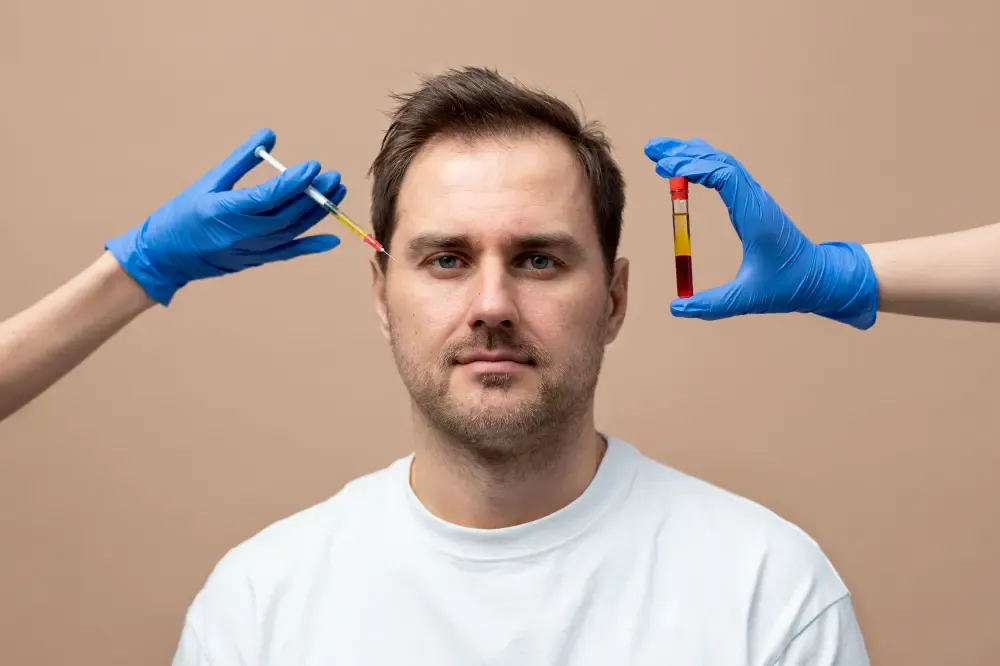
PRP for Beard Growth London: Fuller, Denser Beard Treatment
GMC-registered doctors using Rein PRP™ and MCT Plasma to stimulate natural beard density at 33 Cavendish Square, London W1G.
Procedure Time
60m60 Mins
Sessions
33 Recommended
Price From
£295£295
Downtime
MinimalMinimal
Key Benefits
- Activates dormant beard follicles naturally
- Increases beard density and hair thickness
- Fills in patchy areas with improved coverage
- 100% autologous — uses your body's own growth factors
- Delivered by three GMC-registered doctors
- Non-surgical, non-hormonal approach
- Minimal downtime — return to normal activities same day
- Two advanced systems: Rein PRP™ and MCT Plasma
Common Target Areas
PRP Beard Treatment London: Achieve a Fuller, Denser Beard Naturally
Struggling with a patchy beard or thin facial hair? PRP for beard growth london at PRP London Clinic offers a natural, clinically-supported solution. Platelet-Rich Plasma therapy delivers concentrated growth factors from your own blood directly to beard follicles — activating dormant follicles, thickening existing hairs, and improving vascularisation to sparse areas.
Our prp beard treatment london is performed exclusively by GMC-registered doctors using two medical-grade preparation systems: the Rein PRP™ System (93–97% platelet recovery) and the MCT Plasma System (photobiomodulation-enhanced PRP). Located at 33 Cavendish Square, London W1G, we treat patients seeking fuller, more even beard coverage without surgery or synthetic hormones.
PRP for beard growth follows the same scientifically-validated principles as PRP for scalp hair loss — growth factors stimulate follicle activity regardless of anatomical location.
This procedure is part of our comprehensive Patchy Beard Growth & Enhancement.
Doctor-Led Treatment and Patient Safety
Every PRP for Beard Growth consultation and treatment at PRP London Clinic is carried out by a GMC-registered doctor. The treating doctor reviews your medical history, assesses whether the treatment is suitable, explains the expected result and risks, and gives you clear aftercare instructions.
How PRP Stimulates Beard Follicles
The Science of PRP for Facial Hair
Beard hair follicles respond to the same growth factor signals as scalp follicles. When concentrated PRP is injected into the beard area, the PDGF, VEGF, EGF, and TGF-β released from activated platelets trigger several beneficial processes:
- Dormant follicle activation — growth factors signal inactive follicles in patchy zones to enter the anagen (growth) phase
- Hair shaft thickening — stimulates the dermal papilla cells to produce thicker, more robust beard hairs
- Improved vascularisation — promotes new blood vessel formation (angiogenesis) around follicles for better nutrient delivery
- Extended growth phase — helps follicles sustain the active growth phase for longer periods
- Healthier skin substrate — improves the underlying facial skin condition, supporting optimal follicle function
Patchy Beard Coverage
The most common reason patients seek patchy beard treatment london is genetically-determined uneven follicle distribution. PRP cannot create new follicles where none exist, but it can activate dormant or miniaturised follicles within patchy areas — often significantly improving coverage and density.
Alopecia Areata Barbae
For patients experiencing autoimmune beard hair loss (alopecia areata barbae), PRP offers a non-steroidal treatment option. Published case reports document successful beard regrowth following 3 PRP sessions with sustained results at 12-month follow-up.
Technique & Products: PRP Beard Enhancement
The beard zone presents unique anatomical considerations compared to scalp treatment. Our prp beard treatment london protocols are specifically adapted for facial skin:
Preparation Systems
Your doctor selects between the Rein PRP™ System (CE Class IIB, 93–97% platelet recovery) or the MCT Plasma System (photobiomodulation-enhanced PRP). Both produce concentrated growth factors optimised for follicle stimulation.
Facial Skin Adaptation
Facial skin is thinner (1–2mm vs 4–5mm on the scalp) and more densely vascularised. This requires shallower injection depths, finer gauge needles, and a more precise approach to avoid excessive bruising. Topical anaesthetic cream is applied for 15–20 minutes before treatment — the facial nerve distribution makes adequate numbing important for patient comfort.
Zone-Targeted Delivery
Rather than treating the entire beard area uniformly, our doctors concentrate injections on specific deficit zones — patchy cheeks, sparse connectors (sideburn-to-chin line), thin jawline borders, or areas of alopecia areata barbae. This targeted approach maximises growth factor delivery where it's needed most.
Growth Direction Awareness
Beard hair grows in multiple directions depending on the facial zone. Our injection angle accounts for the natural follicle orientation in each area, optimising PRP delivery to the dermal papilla of each follicle.
Step-by-Step: The PRP Beard Growth Protocol
Our GMC-registered doctors follow a precise protocol adapted specifically for the facial skin and beard follicle anatomy.
Beard Pattern Assessment
Your doctor maps areas of patchiness, density variation, and growth direction across the beard zone to create a targeted treatment plan.
Precision Blood Draw
A small blood sample is drawn from your arm using sterile vacuum-sealed phlebotomy equipment to ensure maximum cell viability.
High-Recovery PRP Processing
Your blood is processed using the Rein PRP™ System (93–97% platelet recovery) or MCT Plasma System at optimised centrifugation settings.
Topical Anaesthesia
Numbing cream is applied to the beard area for 15–20 minutes. The facial skin is more sensitive than the scalp, so adequate anaesthesia is important for comfort.
Targeted Micro-Injections
Using fine-gauge needles, your doctor performs precise injections across the mapped beard zones — concentrating on patchy areas, jawline borders, and areas of thin growth.
Aftercare & Follow-Up
Post-treatment instructions are provided. Your next session is typically scheduled 4–6 weeks later to build cumulative growth factor stimulation.
PRP vs Other Beard Enhancement Options
| Factor | PRP for Beard Growth | Minoxidil (Topical) | Beard Transplant Surgery |
|---|---|---|---|
| How it works | Growth factor stimulation of existing follicles | Increases blood flow to follicles | Surgically implants follicles from donor area |
| Procedure | Micro-injections (60 mins) | Daily topical application | Surgery (4–8 hours) |
| Downtime | Minimal (same day return) | None | 1–2 weeks recovery |
| Creates new follicles? | No — activates existing dormant follicles | No — enhances blood flow to existing follicles | Yes — relocates follicles from donor site |
| Results timeline | 3–6 months visible improvement | 2–4 months (must continue daily use) | 6–12 months for full maturation |
| Side effects | Mild redness, temporary tenderness | Facial skin irritation, dryness possible | Surgical risks, scarring, donor site recovery |
| Maintenance | Every 6–12 months | Daily (results reverse if stopped) | Permanent (no maintenance) |
PRP Beard Treatment Cost
PRP beard growth cost at PRP London Clinic starts from £295 per session. We recommend a course of 3 sessions spaced 4–6 weeks apart for optimal results, with maintenance treatments every 6–12 months.
Your consultation includes a full beard pattern assessment and personalised treatment plan with transparent pricing before you commit. The cost depends on the preparation system used (Rein PRP™ or MCT Plasma) and whether combination protocols are appropriate.
Safety of PRP Beard Injections
PRP beard treatment is very safe due to its autologous nature — using your own blood virtually eliminates allergy and rejection risks. The facial skin is more vascularised than the scalp, which means slightly more redness immediately after treatment, but this typically resolves within hours.
Temporary side effects may include:
- Mild redness and swelling in the beard area (resolves within 24–48 hours)
- Minor pinpoint bruising at injection sites (uncommon)
- Temporary tenderness when touching the treated area
All treatments are performed under sterile conditions by our GMC-registered doctors using single-use, CE-certified equipment. A full medical history review and contraindication screening is completed before every treatment.
PRP Beard Treatment Aftercare
First 24–48 Hours
- Avoid shaving or trimming the treated area for at least 24 hours
- Do not apply beard oils, balms, or styling products for 24 hours
- Avoid touching or rubbing the treated area
- Skip strenuous exercise, saunas, and steam rooms
- Avoid anti-inflammatory medications (ibuprofen, aspirin)
First 2 Weeks
- Use a gentle face wash; avoid harsh exfoliants on the beard area
- Protect the area from excessive sun exposure
- Resume normal beard grooming routine after 48 hours
Follow-Up
Your next session is typically scheduled 4–6 weeks after treatment. Results develop gradually over 3–6 months as stimulated follicles enter and progress through the growth cycle.
Is PRP Beard Treatment Right for You?
| Ideal Candidate | May Need an Alternative Approach |
|---|---|
| Patchy beard with visible dormant or miniaturised follicles | Complete absence of follicles in desired beard areas (transplant needed) |
| Thin beard seeking increased density and thickness | Satisfied with current growth but wants styling changes only |
| Healthy platelet count and no blood disorders | Platelet dysfunction or active anticoagulant therapy |
| Willing to commit to 3 sessions for best results | Seeking instant, permanent results from a single treatment |
| Alopecia areata barbae in early-moderate stage | Active cystic acne or infection in the beard area |
| Looking for a non-surgical, hormone-free approach | Genetic absence of follicles in target zones (no follicles to stimulate) |
Contraindications for PRP Beard Treatment
PRP for beard growth is not suitable for all patients. The following conditions require consideration:
- Active skin infection or folliculitis in the beard area — must be fully resolved before treatment
- Active cystic acne in the treatment zone — injections could aggravate breakouts
- Complete follicular absence — PRP stimulates existing follicles but cannot create new ones. If no follicles exist in the target area, a beard transplant may be more appropriate
- Platelet disorders or anticoagulant therapy — requires medical review
- Autoimmune conditions affecting hair universally (alopecia universalis) — may not respond to localised PRP
- Active malignancy — growth factors may theoretically stimulate cancerous cells
Clinical Disclaimer
PRP therapy is a biological medical procedure. Individual results vary based on age, genetics, existing follicle density, and baseline health. PRP aims to maximise your natural beard potential — it cannot guarantee a perfectly uniform, dense beard, and it cannot create new follicles where none exist genetically. A professional consultation is required to set realistic expectations.
Last medical review: March 2026.
PRP Beard Treatment in London W1
PRP London Clinic is located at 33 Cavendish Square, London W1G 0PW — in the heart of London's medical district, moments from Oxford Circus and Bond Street stations. Our dedicated clinical premises provide a private, professional environment for your prp beard london treatment.
Whether you're searching for beard growth treatment london in central London or travelling from further afield, our Cavendish Square location is easily accessible by tube, bus, and car.
Book Your Beard Growth Consultation
Ready to achieve a fuller, denser beard? Book a consultation with one of our three GMC-registered doctors at PRP London Clinic. We'll assess your beard pattern, confirm PRP suitability, and create a personalised prp for beard growth treatment plan with transparent pricing.
Myths vs Facts
PRP can make a beard grow where no follicles exist.
False. PRP stimulates existing hair follicles — including dormant or miniaturised ones. It cannot create new follicles where they are genetically absent. This is why a clinical assessment maps your follicle distribution before treatment.
PRP beard treatment results are instant.
No. Like scalp hair, beard growth follows natural cycles. Visible improvements in density typically appear at 3–6 months as stimulated follicles progress through the growth phase.
Injecting PRP in the beard area is very painful.
Topical anaesthetic cream is applied for 15–20 minutes before treatment, and our doctors use fine-gauge needles. Most patients report the procedure is very tolerable.
PRP guarantees a perfectly even, dense beard.
PRP aims to maximise your natural genetic potential. It can significantly improve density and fill patchy areas, but results depend on your existing follicle distribution and individual biology.
Only beard transplant surgery can fix a patchy beard.
Not necessarily. Many patients with dormant follicles in patchy areas respond well to PRP stimulation without surgery. Transplants are typically reserved for areas with complete follicular absence.
PRP beard treatment requires testosterone supplementation.
False. PRP is a non-hormonal treatment that works through growth factor stimulation, not testosterone. It is suitable for patients regardless of their hormonal profile.
Price: PRP for Beard Growth
| Treatment | Price |
|---|---|
| PRP for Beard Growth Per session. Course of 3 sessions recommended. | £295per treatment |
| MCT Plasma for Beard Growth Per session. Photobiomodulation-enhanced platelet therapy (MCT Plasma) for beard density. Course of 3 recommended. | £450per treatment |
Prices are indicative. Please book a consultation for a personalised quote.
Frequently Asked Questions
Clinical Evidence & Scientific References
Gupta et al. (2019): PRP Efficacy in Hair Restoration and Facial Aesthetics — Systematic Review and Meta-analysis
A.K. Gupta, S.G. Versteeg, J. Rapaport, A.K. Hausauer, N.H. Shear, V. Piguet · Journal of Cutaneous Medicine and Surgery, 2019PMID: 30606055
Supports: Systematic review and meta-analysis demonstrating 3 monthly PRP injections exhibit significantly greater efficacy over placebo for hair density in androgenetic alopecia (mean difference: 25.61 hairs/cm², P=0.02). Also found 2-4 PRP sessions combined with traditional therapies can minimise acne scarring and improve aesthetic outcomes — supporting PRP's broad application across hair and facial rejuvenation.
Limitations: Studies used half-head design which may have influenced results due to systemic PRP effects. Data for non-hair indications (scarring, facial burns, ageing skin) are less robust in design. Focused on mild AGA — less evidence for advanced hair loss stages.
Read more →Zhang et al. (2023): PRP for Androgenetic Alopecia — Systematic Review and Meta-Analysis of RCTs
X. Zhang, Y. Ji, M. Zhou, X. Zhou, Y. Xie, X. Zeng, F. Shao, C. Zhang · Canadian Journal of Plastic Surgery, 2023PMID: 37533146
Supports: 2023 systematic review and meta-analysis of 9 RCTs (238 patients) demonstrating PRP significantly increases hair density at 3 and 6 months compared with placebo (P<.05) in androgenetic alopecia. No serious adverse reactions reported across studies.
Limitations: Relatively small total sample size (238 patients across 9 RCTs). PRP increased hair count and hair diameter vs baseline but without statistically significant difference vs placebo. Heterogeneity in PRP preparation protocols across included studies.
Read more →Rahman et al. (2024): Systematic Review of PRP in Medical and Surgical Specialties
E. Rahman, P. Rao, H.N. Abu-Farsakh, C. Thonse, I. Ali, A.E. Upton, S.Y. Baratikkae, J.D.A. Carruthers, A. Mosahebi, N. Heidari, W.R. Webb · Journal of Clinical Medicine, 2024PMID: 39124838
Supports: 2024 PRISMA systematic review of 75 RCTs (5,726 patients) across aesthetics and orthopaedics. Found strong positive correlation (r=0.79) between proper temperature control during PRP preparation and efficacy, and moderate correlation (r=0.57) between initial platelet count assessment and outcomes — supporting the clinic's use of controlled, high-recovery PRP preparation systems.
Limitations: Identified significant variability in PRP preparation methods across studies, making direct comparison difficult. Proposed a new scoring system (WESS-PQR) to address inconsistencies, but this has not yet been widely adopted or validated independently.
Read more →*PRP London Clinic provides these references for educational purposes. Our Clinical Board regularly reviews emerging peer-reviewed literature to ensure our protocols align with the latest advancements in regenerative medicine.
Quick Links
Our Medical Team
Your treatment will be performed by one of our qualified medical professionals

Dr Mohamed Nafei
GMC: 7520509GMC-registered doctor with 10+ years experience. Expert in PRP, exosomes, and ad...
Profile
Dr Reem Nouri
GMC: 6149512GMC-registered doctor with nearly 20 years of medical experience including 10+ y...
Profile
Dr Kaveetha Kandiah
GMC: 7595211GMC-registered doctor with more than 8 years of postgraduate medical experience....
ProfileScroll to see all
Ready to Get Started?
Book your consultation today and take the first step towards your transformation.
Book ConsultationVerified Clinical Reputation
Ruby K
19 Jan 2026
Norin Hanifi
19 Jan 2026
Dominique Heslop
13 Jan 2026
lloyda221
06 Jan 2026
Mane Authority
06 Jan 2026
Victor Contreras Guerra
4 months ago
A A
5 months ago
harris jan
3 months ago
Independent Patient Feedback
Read all verified stories →Medical Suitability Note
As a GMC-regulated practice, a mandatory consultation is required for all new patients to assess suitability and clinical need. This treatment may not be appropriate for everyone. All procedures are performed by GMC-registered doctors whose credentials can be verified on the official GMC register.
Clinical Technology & Equipment
Rein PRP™ System
byRein PRP
CE Class IIB certified medical preparation system using 3.13% Sodium Citrate for high-yield (4-6x) autologous platelet recovery. Manufactured in ISO Class 8 cleanroom environments.
Certifications
Technical Specifications
- Platelet Recovery Rate
- 93-97%
- Centrifugation Protocol
- 850 G for 8 minutes
- Anticoagulant
- 1ml Sodium Citrate 3.13% Ph. Eur.
Clinical Applications
Contraindications
Official Resources
MCT System (Meta Cell Technology)
byMCT
CE/MDR-certified dual-function medical device providing both Advanced PRP (MCT Plasma) and autologous exosome preparation. Uses photobiomodulation (blue light) and thermal biomodulation to enhance platelet performance, boost growth factor release, and stimulate autologous exosome production from the patient's own cells.
Certifications
Technical Specifications
- MCT Plasma Mechanism
- Photobiomodulation + Thermal Biomodulation of PRP for sustained growth factor release and reduced pro-inflammatory cytokines
- MCT Exosome Source
- Autologous — photothermal conditioning stimulates exosome release from patient's own cells and platelets
- ATP Enhancement
- Photothermal biomodulation stimulates cellular metabolism and enhances ATP synthesis
- Platelet Activation
- Reduces VASP, increases p-38 phosphorylation; cold priming facilitates reactivity post-injection
- Procedure Benefit
- Cold temperature delays clot formation, producing less dense plasma for improved patient comfort
Clinical Applications
Official Resources
This technical specification is provided for informational purposes only. All medical devices and substances are used exclusively by GMC-registered practitioners at PRP London Clinic. Individual results may vary.